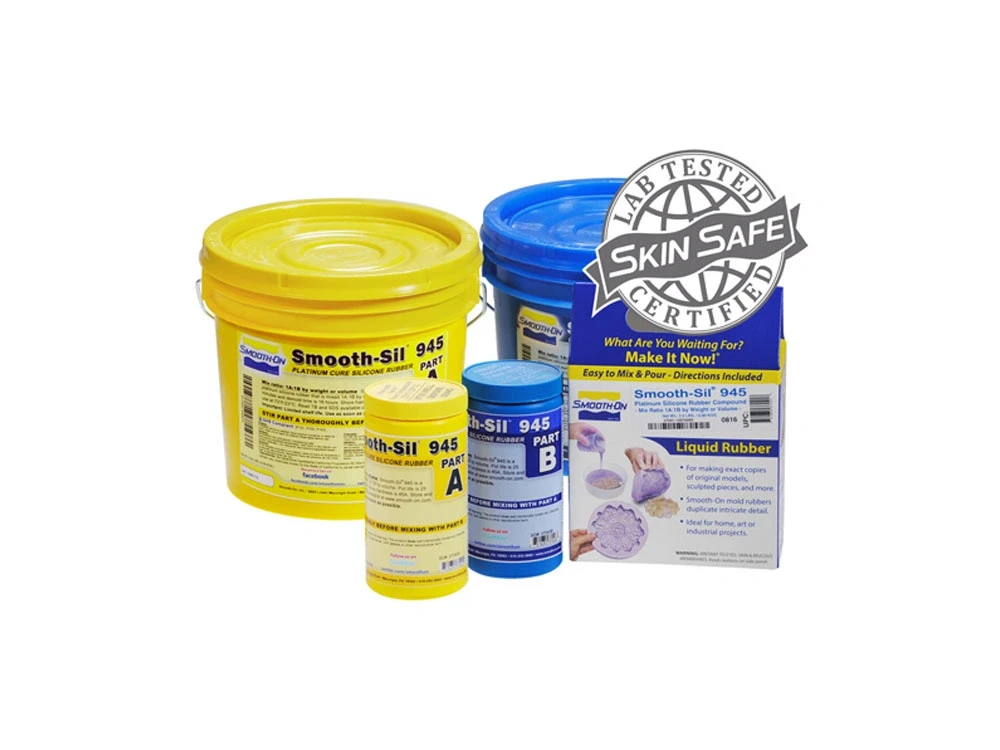
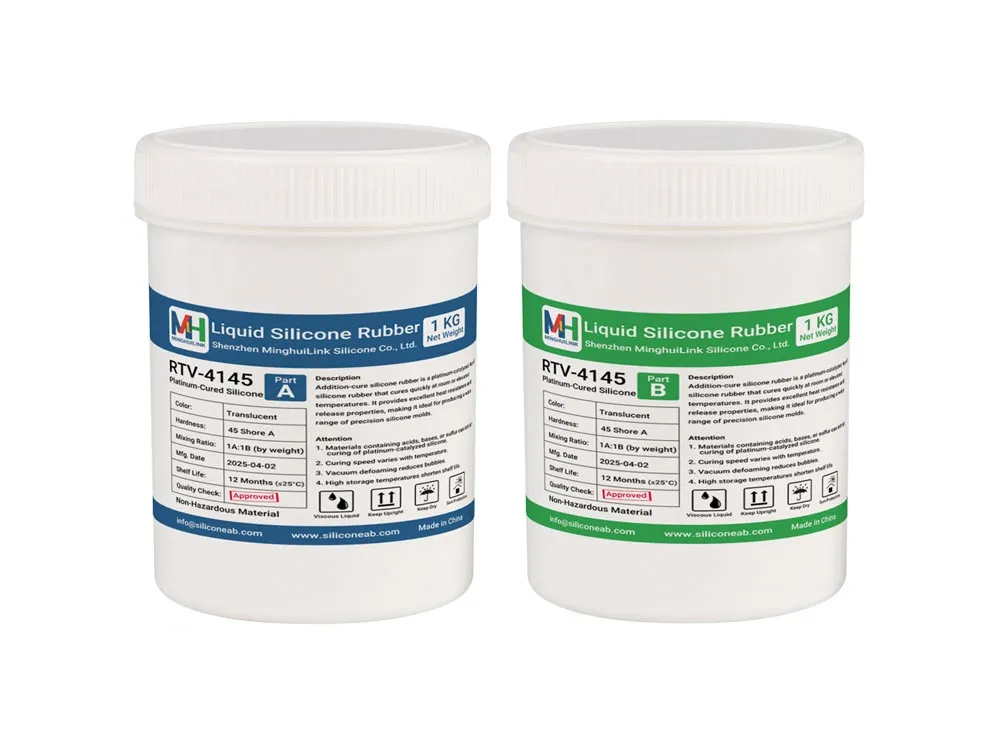
Smooth-Sil™ 945 and RTV-4145 are both Shore A45 platinum-cure silicones with a relatively firm cured profile for reusable molds. This level of hardness can provide useful resistance to deformation during casting and handling while retaining more flexibility than rigid mold materials. For users selecting an A45 silicone, mold geometry and demolding requirements can be just as important as hardness itself.
Both materials use a 1:1 mixing ratio by weight or volume, so component proportioning is relatively straightforward for either system. The more noticeable difference appears in published viscosity. Smooth-On lists 30,000 cps for Smooth-Sil™ 945, while MinghuiLink lists 8,500±200 mPa·s for Part A of RTV-4145. Because these values are reported at different measurement points, they should not be treated as a strict like-for-like viscosity ranking. However, the published figures indicate different processing and handling characteristics.
The working windows are also somewhat different. Smooth-On lists a 25-minute pot life for Smooth-Sil™ 945, while MinghuiLink lists a 30–40-minute working time for RTV-4145. The longer stated working window of RTV-4145 may provide more flexibility during mixing and pouring. Cure times are much closer, with approximately 6 hours for Smooth-Sil™ 945 and 5–6 hours for RTV-4145 under the respective manufacturers’ stated conditions.
The published mechanical data show different material profiles rather than a simple overall winner. Smooth-Sil™ 945 reports approximately 4.83 MPa tensile strength, 21.0 N/mm tear strength and 320% elongation. RTV-4145 reports 4.7±0.5 MPa tensile strength, 30±0.5 N/mm tear strength and 230±50% elongation. RTV-4145 reports the higher published tear-strength value, while Smooth-Sil™ 945 reports higher published elongation and a similar tensile-strength range. These figures should be treated as published reference data rather than a direct laboratory ranking because testing methods and conditions may differ.
For reusable mold applications, including production molds, resin casting and prototyping, the relevant differences are therefore primarily in processing characteristics and mechanical profile rather than hardness or mixing ratio. The published viscosity, working time, tear strength and elongation can help narrow the choice, but actual performance will also depend on mold geometry, casting material, demolding requirements and process conditions. Complex undercuts and demanding demolding conditions should be evaluated with the actual mold design before full-scale production.