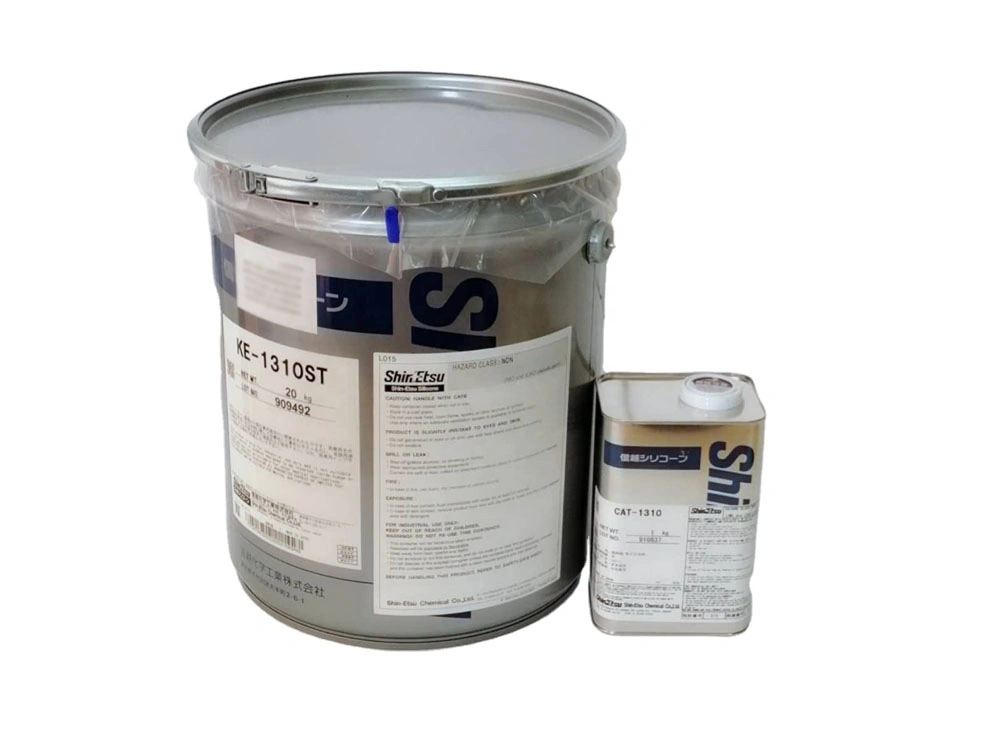
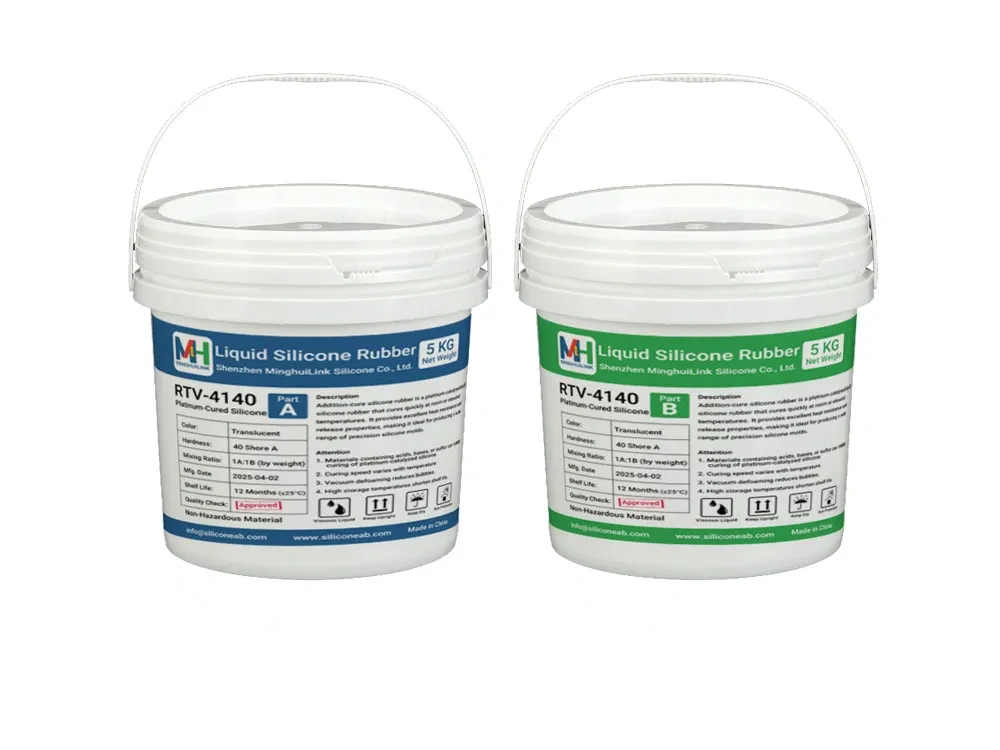
KE-1310ST/CAT-1310 and RTV-4140 are both Shore A40 addition-cure silicone systems, but they serve different priorities in mold making. KE-1310ST is a specialized high-strength, high-modulus formulation with a high platinum catalyst level specifically intended to help overcome cure inhibition and improved resistance to urethane casting resins. RTV-4140 is a more general-purpose A40 platinum-cure silicone focused on simpler 1:1 processing, lower published component viscosity and faster mold turnaround.
The most important distinction is KE-1310ST's inhibition-resistant formulation. Shin-Etsu specifically identifies its high platinum level as a feature for helping overcome cure inhibition, which can be a critical issue when silicone is used against difficult masters, coatings or process materials. Platinum-cure inhibition may occur with sulfur-containing materials, amines, tin compounds, certain resins and other contaminants. For mold makers who have experienced incomplete curing or sticky silicone against a particular master, this specialized formulation can be more relevant than Shore hardness alone.
KE-1310ST also has a distinct advantage in polyurethane mold applications because Shin-Etsu documents improved urethane resistance. This is particularly important when the same mold is repeatedly exposed to polyurethane casting resins, where long-term resistance to the casting material can be more important than the ability to produce a single successful casting. RTV-4140 can be used for polyurethane casting, but its current published documentation does not make an equivalent special urethane-resistance claim.
The processing systems are substantially different. KE-1310ST/CAT-1310 uses a 100:10 mix ratio by weight and provides approximately 2 hours of working time, giving operators more time for large-batch preparation, vacuum deaeration and controlled pouring. RTV-4140 uses a 1:1 ratio by weight or volume with a published working time of approximately 35 minutes. This makes RTV-4140 considerably simpler to batch, while KE-1310ST provides a much longer processing window for larger or more demanding molds.
Viscosity is another major difference. Shin-Etsu reports a base viscosity of 75 Pa·s, equivalent to approximately 75,000 cP, for KE-1310ST, while MinghuiLink reports approximately 4,800±200 mPa·s for Part A of RTV-4140. Because these measurements are taken at different points in the respective systems, they should not be treated as a strict like-for-like laboratory ranking. The published figures nevertheless indicate that KE-1310ST is a much higher-viscosity material, making mixing, vacuum deaeration and controlled pouring more important, while RTV-4140 is easier to handle when lower viscosity is preferred.
The mechanical data show a mixed result rather than a simple winner. KE-1310ST reports 5.90 MPa tensile strength, 23 kN/m tear strength and 380% elongation, while RTV-4140 reports 5.3 MPa tensile strength, 32.0 N/mm tear strength and 220% elongation. On the published figures, KE-1310ST reports higher tensile strength and elongation, while RTV-4140 reports the higher tear-strength value. Because the manufacturers use different test methods and reporting conditions, these figures should be treated as published reference data rather than a universal mechanical ranking.
Overall, KE-1310ST is best understood as a specialized solution for demanding mold-making conditions rather than simply another A40 silicone. Its high platinum formulation for overcoming inhibition and its improved urethane resistance are particularly relevant for difficult masters and repeated polyurethane casting. RTV-4140, by contrast, is more attractive where straightforward 1:1 mixing, lower published component viscosity and faster cure turnaround are the primary requirements. Final selection should therefore be based on the actual casting resin, master surface, mold geometry, production frequency and tolerance for processing complexity.