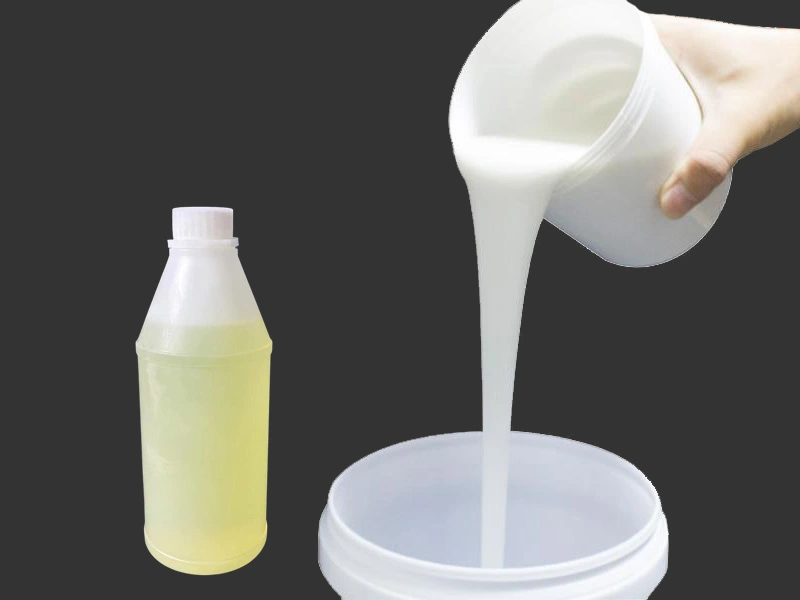
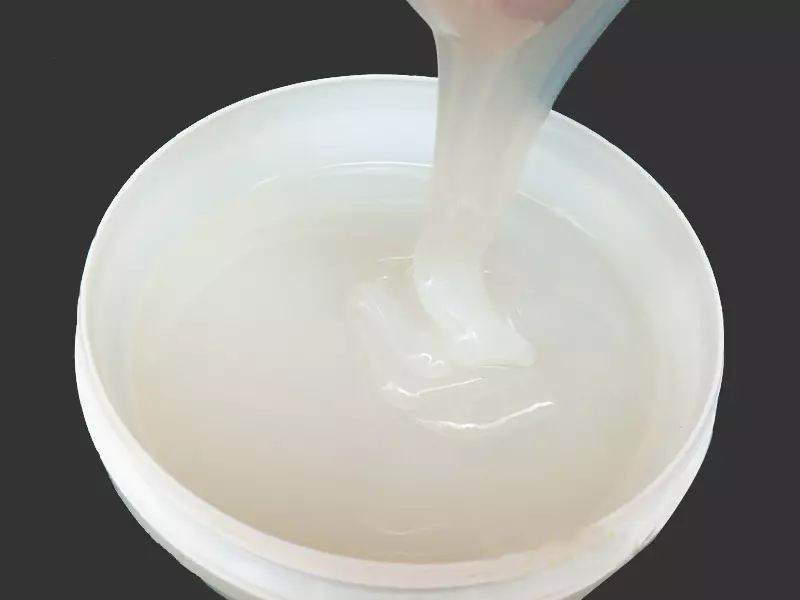
Vacuum casting silicone is a two-part liquid silicone rubber specially designed for rapid prototyping and small-batch production. It typically uses an RTV-2 room-temperature vulcanizing system and is available in both condensation-cure and addition-cure formulations.
Compared with general-purpose mold making silicone, vacuum casting silicone places greater emphasis on mold dimensional stability, hardness, mechanical strength, and detail reproduction. Once cured, the silicone mold can be used with vacuum casting equipment to produce prototype parts with complex structures and fine surface details, using materials such as polyurethane (PU) resin.
The vacuum casting process is widely used for rapid prototyping in automotive components, consumer electronics housings, medical equipment enclosures, and other industrial products. Silicone molds make it possible to reproduce small batches of products and validate their appearance and structure without the need for an initial investment in rigid metal tooling.
This article introduces the key characteristics and mold-making advantages of vacuum casting silicone, its common applications, and important considerations for material selection and practical use.
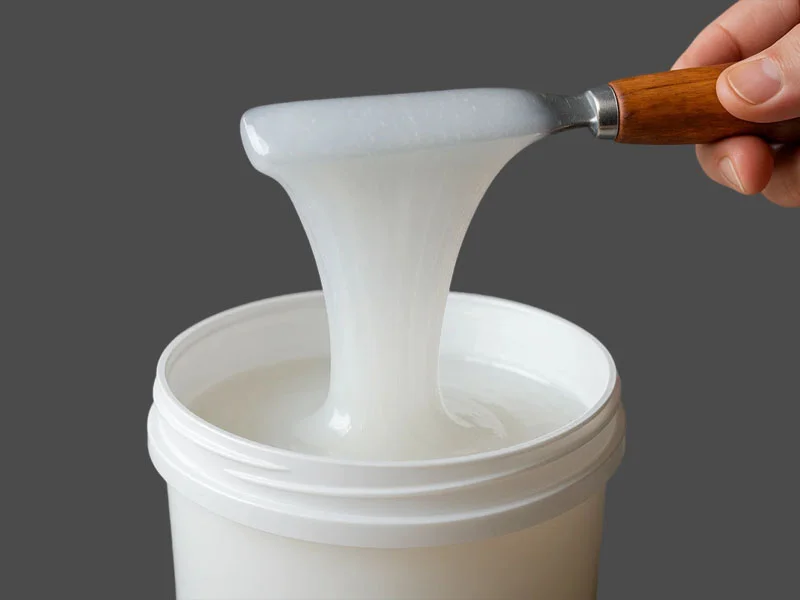 Vacuum casting silicone
1. What Is Vacuum Casting Silicone?
Vacuum casting silicone is a two-part room-temperature vulcanizing silicone rubber (RTV-2) used to make molds for vacuum casting. It is primarily designed for rapid prototyping and small-batch production, and is commonly used to produce flexible molds for casting polyurethane resin and other compatible materials.
The basic mold-making process involves pouring liquid silicone around a master pattern, followed by vacuum degassing and curing. Once cured, the silicone mold is cut along a predetermined parting line and the master pattern is removed, leaving a mold cavity that reproduces the original part. The mold is then reassembled and placed in a vacuum casting machine, where the corresponding resin is poured to produce duplicate parts.
It is important to distinguish between vacuum casting silicone, vacuum degassing, and the vacuum casting process. They are three different concepts:
- Vacuum casting silicone: The silicone rubber material used to make flexible reproduction molds.
- Vacuum degassing: A process that uses vacuum equipment to remove air from mixed liquid silicone, reducing bubbles inside the mold.
- Vacuum casting: A process in which resin is poured into a silicone mold with the assistance of a vacuum environment to facilitate filling and molding.
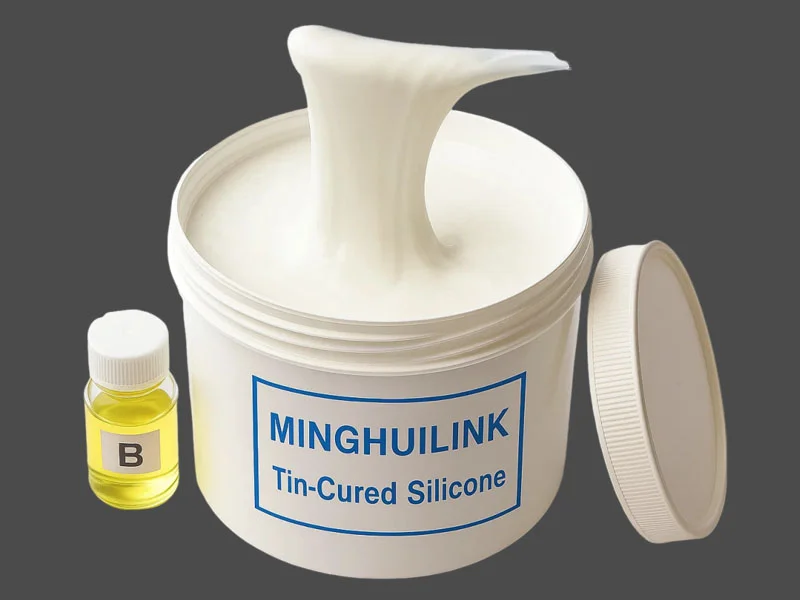
Vacuum casting silicone is currently available in two main curing systems: tin-cured and platinum-cured. Different systems and product grades may vary in hardness, mix ratio, viscosity, pot life, cure time, and mechanical properties. The appropriate product should be selected according to the specific application.
2. Key Advantages
2.1 Higher Hardness for Better Mold Dimensional Stability
Dimensional stability is one of the most important performance requirements for vacuum casting silicone molds.
During vacuum casting, silicone molds undergo repeated operations such as mold assembly, clamping, vacuum-assisted pouring, and demolding. If the material is not sufficiently hard or the mold lacks adequate structural support, the cavity may deform, affecting the dimensions and geometric accuracy of the reproduced parts.
Vacuum casting silicone typically uses medium- to high-hardness formulations, allowing cured molds to retain their shape more effectively.
For example, MinghuiLink's vacuum casting silicone range covers a hardness range of approximately 35–50 Shore A, providing options for different mold structures and prototype reproduction projects.
Higher hardness helps reduce mold deformation during handling and pouring. It is particularly suitable for larger molds, relatively complex structures, and prototype applications with demanding dimensional accuracy requirements.
However, higher hardness is not always better. For molds with deep undercuts, complex curved surfaces, or narrow demolding areas, flexibility and tear strength must also be taken into consideration.
2.2 High Mechanical Strength for Repeated Casting
Vacuum casting is commonly used to produce multiple identical or similar prototype parts. Therefore, the mold needs to withstand repeated assembly, pouring, and demolding operations.
If the silicone does not have sufficient mechanical strength, repeated use may cause edge tearing, localized damage, or cavity deformation, affecting the quality of subsequent reproductions.
Vacuum casting silicone typically uses higher-strength formulations to improve the mold's ability to withstand mechanical stress and reduce damage during normal operation.
Tear strength is one of the key indicators of silicone mold durability. Particular attention should be paid to tear strength around parting lines, pouring gates, thin-walled sections, and complex undercuts.
It is important to note that actual mold service life is also affected by the resin material, pouring temperature, mold design, demolding method, and maintenance conditions. It cannot be determined solely by silicone hardness or any single physical property.
2.3 Excellent Detail Reproduction
Rapid prototype parts often need to reproduce the master pattern's surface textures, edge contours, holes, and complex geometric features. Therefore, the detail reproduction capability of the silicone mold is particularly important.
Vacuum casting silicone offers good detail reproduction performance. With proper mold-making techniques, it can transfer the textures, raised and recessed features, and fine contours of the master pattern surface to the mold cavity.
For automotive interior components, electronic product housings, decorative parts, and other industrial prototypes, good detail reproduction helps improve the surface quality and appearance consistency of reproduced parts.
The final reproduction quality depends not only on the silicone itself but also on master pattern surface quality, silicone viscosity, mixing uniformity, vacuum degassing effectiveness, and mold-making methods.
2.4 Good Heat Resistance for Resin Curing Processes
During vacuum casting, commonly used PU resins may release heat during mixing and curing. The mold must withstand the heat generated during resin curing as well as the temperature conditions specified by the actual process.
Vacuum casting silicone generally offers heat resistance suitable for its intended reproduction processes. Under specified conditions of use, it can maintain mold structure and performance while helping minimize changes caused by heat released during resin curing.
For resin systems that require heated curing, the silicone grade should also be selected according to the resin's curing temperature, heat release characteristics, and actual processing conditions.
It is important to note that the heat resistance of different silicone products varies. A product should not be assumed to be suitable for every high-temperature resin or heated process simply because it is classified as vacuum casting silicone. Always refer to the product's technical data sheet and conduct process testing in advance.
2.5 Good Release Properties for Reproducing Complex Parts
Vacuum casting molds are often used to reproduce parts with holes, grooves, curved surfaces, and certain undercut features. Once cured, the silicone needs to have suitable elasticity and release properties so that reproduced parts can be removed from the mold cavity.
Silicone materials have a certain degree of flexibility and can deform appropriately during demolding. Combined with a well-designed parting line, this flexibility helps reduce the difficulty of releasing parts with complex structures.
In addition, vacuum casting silicone generally offers good release performance, helping reduce sticking between the reproduced parts and the mold cavity and making repeated production easier.
For parts with deep undercuts, thin walls, or complex geometries, the mold design must still be carefully considered. Parting surfaces, auxiliary cuts, and demolding directions should be planned appropriately. A release agent compatible with the resin system can be used when necessary.
2.6 Transparent or Translucent Options for Easier Mold Cutting
Some vacuum casting silicone products are available in transparent or translucent formulations, providing better visibility during mold making.
Vacuum casting molds usually need to be cut along parting lines after the silicone has cured so that the master pattern can be removed and a complete mold cavity can be formed. For master patterns with complex shapes, deep grooves, or multiple undercuts, the transparency of the material helps operators observe the internal structure and determine where to cut.
Translucent silicone can also make it easier to identify the outline of the master pattern inside the mold, reducing the risk of accidentally damaging important features during cutting.
However, transparency cannot replace proper parting line design or professional mold-cutting techniques. For particularly complex master patterns, the cutting path should still be planned in advance to avoid affecting the accuracy of repeated mold assembly.
2.7 Available in Tin-Cured and Platinum-Cured Systems
Different vacuum casting projects may have different requirements for material performance, working time, curing methods, and cost.
Vacuum casting silicone is available in both tin-cured and platinum-cured systems, allowing users to select a suitable product according to their actual project requirements.
- Tin-cured silicone: Has an established history of use in mold making and is suitable for a wide range of industrial master patterns and reproduction projects. Different products vary in hardness, strength, mix ratio, and cure time.
- Platinum-cured silicone: Available in different hardness and transparency options. Some grades offer high tear strength and are suitable for projects with specific mold performance and reproduction requirements.
It is important to note that these two curing systems differ in formulation, mix ratio, curing reaction, and material compatibility. Do not mix Part A and Part B from different systems, and do not apply the processing parameters of one product grade directly to another.
3. Applications
Vacuum casting silicone is primarily used in rapid prototyping, small-batch reproduction, and industrial product development. It is particularly suitable for projects that require good surface quality, detailed structures, and material performance validation.
3.1 Automotive Component Prototypes
Automotive components are a common application of rapid prototyping.
During automotive design and development, prototypes of certain interior components, exterior parts, and functional components need to be produced first to evaluate their structure, appearance, and assembly performance.
Vacuum casting silicone can be used to make reproduction molds for these parts. Different PU resin formulations can then be poured into the molds to reproduce dashboard components, automotive grilles, interior trim parts, and other prototype components.
Depending on the resin grade, reproduced parts can achieve an appearance and certain performance characteristics similar to those of ABS, PC, or other engineering plastics.
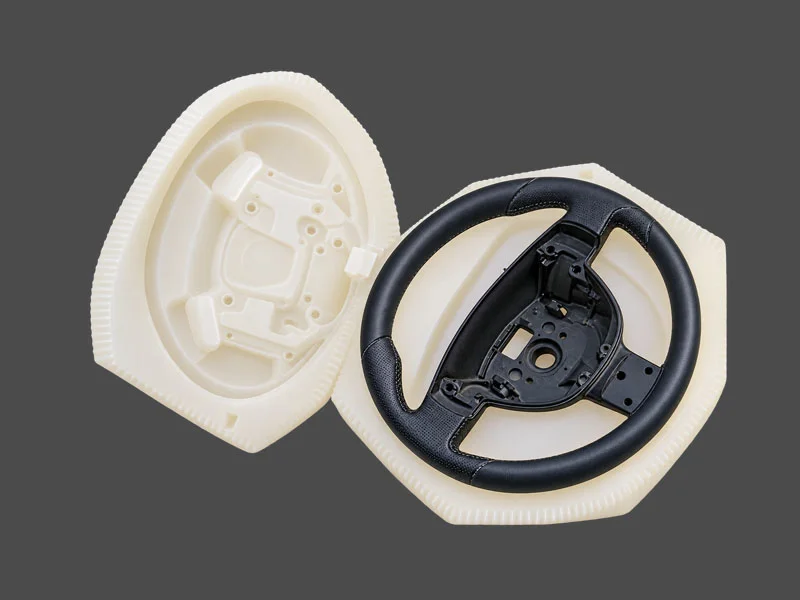 Silicone mold for automotive steering wheels
3.2 Consumer Electronics Housings
Consumer electronics products often have complex housing contours, button structures, interface openings, and surface textures.
During product development, vacuum casting silicone can be used to make molds for electronic product housings, followed by small-batch reproduction using compatible PU resin.
Common applications include:
- Electronic device housings and protective cases.
- Control panels and user interface components.
- Household appliance housings.
- Structural validation models for electronic products.
- Decorative components with fine surface textures.
This method is suitable for product design validation, appearance evaluation, and small-batch prototype production.
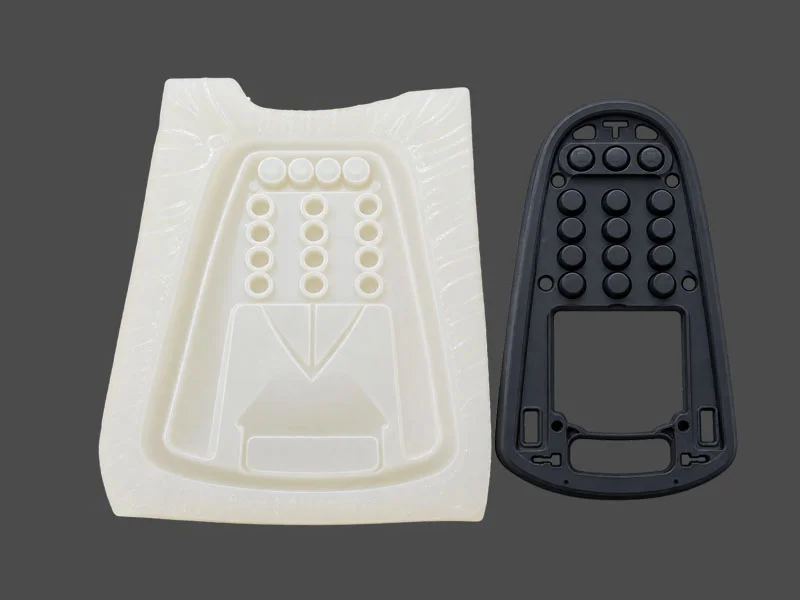 Silicone mold for electronic product enclosures
3.3 Medical Equipment Housings and Structural Prototypes
During the development of medical equipment, housings, structural components, and presentation samples often need to be produced for dimensional inspection, assembly verification, and appearance evaluation.
Vacuum casting silicone can be used to reproduce medical equipment housings, device panels, and other non-implantable prototype components with complex contours and detailed structures.
It is important to note that prototype parts made through vacuum casting are not automatically qualified for medical device use. Whether a finished product is suitable for clinical applications or human contact must be evaluated according to the materials, structure, and actual conditions of use.
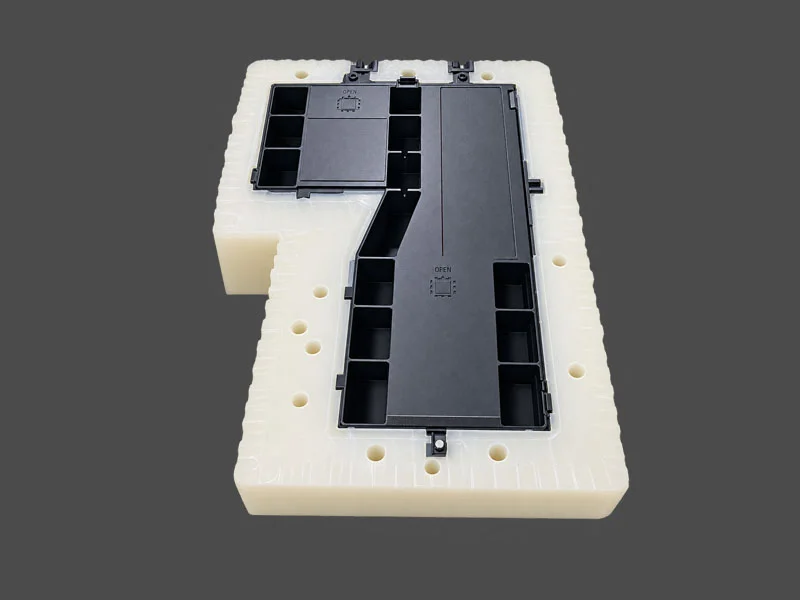 Silicone mold for medical equipment housings
3.4 Rapid Prototyping and Small-Batch Production
Vacuum casting is a widely used method for rapid prototyping and small-batch production.
When a product is still in the design validation stage, or the required quantity is too small to justify metal injection mold tooling, a master pattern can first be produced using 3D printing or another manufacturing method. Vacuum casting silicone is then used to make a flexible reproduction mold.
This process can reproduce parts with complex geometries. By selecting different PU resin formulations, prototypes with different hardness, flexibility, transparency, and other performance characteristics can be produced.
Therefore, vacuum casting is commonly used for product appearance evaluation, assembly testing, functional prototyping, and market validation.
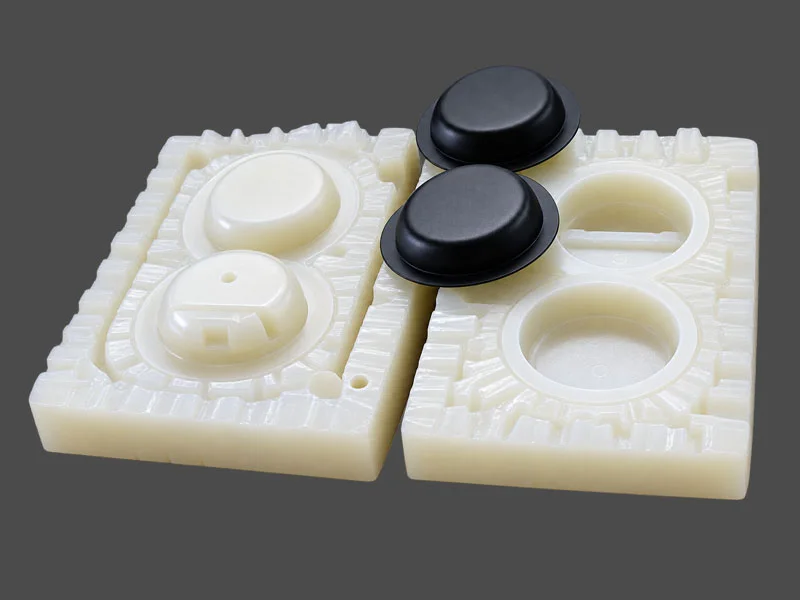 Silicone mold for vacuum casting
3.5 Presentation Models and Industrial Design Prototypes
Vacuum casting silicone can also be used to produce presentation models and industrial design prototypes for projects that require a clear demonstration of product appearance, structure, and surface finish.
For example, robot housings, scientific instrument components, product design models, and other industrial presentation parts can be reproduced in small batches using silicone molds.
By selecting casting resins with different properties, reproduced parts can also be made with a certain degree of rigidity, flexibility, transparency, or other desired characteristics.
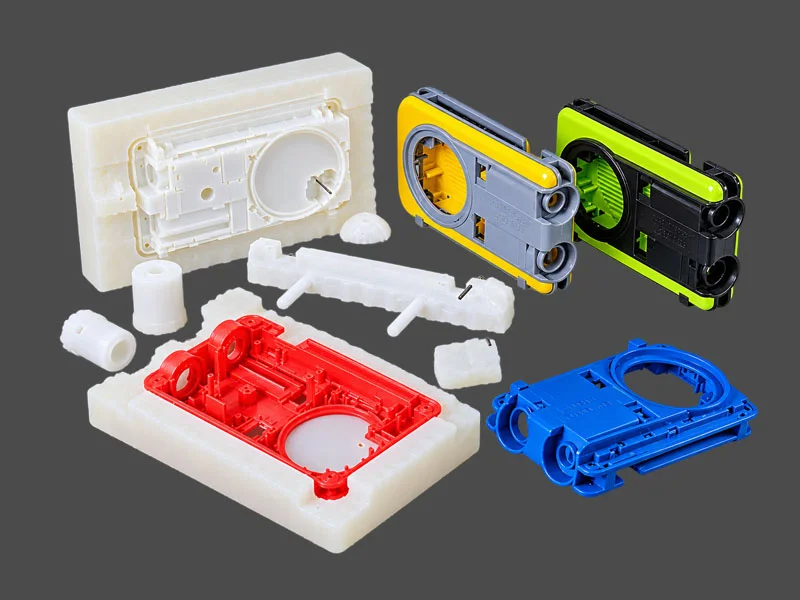 Silicone mold for industrial design prototypes
4. How to Choose
Different vacuum casting projects have different mold performance requirements. When selecting a product, do not focus on silicone hardness alone. Tear strength, dimensional stability, viscosity, transparency, heat resistance, and resin compatibility should also be considered.
4.1 Select Hardness Based on Mold Design
Hardness affects the support capability, deformation, and demolding performance of silicone molds.
Vacuum casting molds generally require a certain level of hardness to maintain cavity dimensions and geometric accuracy.
The following guidelines can be used when selecting a product:
- Medium-hardness silicone: Suitable for prototype reproduction with conventional structures, offering a balance between shape retention and flexibility during demolding.
- Higher-hardness silicone: Suitable for projects with greater requirements for dimensional stability and mold support.
- Complex undercut structures: Require consideration of both material elongation and tear strength. The product with the highest hardness is not necessarily the best choice.
For example, some products in MinghuiLink's current vacuum casting silicone range cover approximately 35–50 Shore A. The specific grade should be selected according to the master pattern structure, reproduced part dimensions, and demolding method.
4.2 Consider Tear Strength and Mechanical Properties
Tear strength is an important indicator of silicone mold durability.
During cutting, mold assembly, and repeated demolding, parting lines, pouring gates, and thin sections of vacuum casting molds may be subjected to considerable mechanical stress.
If tear strength is insufficient, the mold may become locally damaged during repeated use, affecting both mold life and the quality of reproduced parts.
Therefore, for projects involving complex structures, numerous thin-walled sections, or repeated casting, compare the tear strength and other mechanical properties of different product grades carefully.
4.3 Select Suitable Viscosity Based on Master Pattern Details
Silicone viscosity affects material flow, pouring, and air release performance.
For master patterns with fine textures, narrow features, or complex contours, suitable flow properties help the silicone make full contact with the master pattern surface and reduce the risk of missing local details.
However, excessively high viscosity may make mixing and pouring more difficult and can also affect the natural release of air bubbles.
When selecting a product, consider the master pattern size, structural complexity, and the operating capacity of the vacuum degassing equipment to determine the appropriate viscosity.
4.4 Choose Transparent or Translucent Silicone Based on Process Requirements
If the master pattern has a complex structure and the mold needs to be opened by cutting after curing, transparent or translucent silicone may be a preferred option.
These materials make it easier to observe the internal contours of the master pattern and identify cutting positions. This helps operators plan the parting line and reduce cutting errors.
If visibility is not a specific project requirement, select a suitable color or transparency grade based on hardness, strength, cost, and other performance requirements.
4.5 Verify Heat Resistance and Resin Compatibility
PU resin is commonly used in vacuum casting, but different resins may vary considerably in mix ratio, viscosity, heat release, and curing temperature.
Therefore, when selecting silicone, confirm that it is suitable for the target resin and can withstand the temperature conditions during the actual pouring and curing process.
For example, some resins generate considerable heat during curing, while certain processes also require the mold or resin to be preheated. Check the technical documentation provided by both the resin supplier and the silicone supplier to confirm the suitable operating conditions.
Do not determine product suitability based solely on names such as "heat-resistant silicone" or "vacuum casting silicone."
4.6 Select Suitable Pot Life and Cure Time
Silicone pot life affects the arrangement of mixing, pouring, and vacuum degassing, while cure time determines the overall mold-making cycle.
For larger master patterns or structurally complex projects, sufficient time should be allowed for mixing and pouring to prevent the material from noticeably thickening before the process is complete.
In addition, ambient temperature affects silicone curing speed. During actual application, control the mix ratio, working time, and curing conditions according to the technical data sheet for the specific product grade.
5. Important Considerations
The final quality of a vacuum casting mold depends not only on the silicone material but also on master pattern quality, mold design, vacuum degassing, and the actual casting process.
5.1 Ensure Good Master Pattern Surface Quality
Vacuum casting silicone reproduces the details of the master pattern surface, so the surface condition of the master pattern directly affects the appearance of the final reproduced parts.
If the master pattern has scratches, dents, dust, or other surface defects, these imperfections will generally also be reproduced in the silicone mold and the final parts.
Before making the mold, inspect the master pattern surface, remove dust and residues, and carry out sanding, polishing, or other surface treatments according to the requirements of the finished product.
For 3D-printed master patterns, also consider how print layer lines, support marks, and material surface conditions may affect the reproduction quality.
5.2 Perform Vacuum Degassing Properly
Air can easily become trapped in liquid silicone during mixing and pouring. If bubbles remain on the mold cavity surface or inside the mold, they may cause pinholes, pits, or other defects on the reproduced parts.
Therefore, vacuum degassing is an important step in making silicone molds for vacuum casting.
Generally, Part A and Part B should be measured separately and mixed thoroughly according to the product's technical documentation. The mixed silicone is then placed in vacuum equipment for degassing to minimize residual air bubbles.
For master patterns with complex structures or demanding surface detail requirements, the pouring method and master pattern positioning should also be considered to reduce trapped air.
It is important to note that degassing time and vacuum level should be determined according to silicone viscosity, pot life, and equipment capability. Do not simply apply a fixed set of parameters to every product.
5.3 Mix Parts A and B Strictly at the Specified Ratio
Vacuum casting silicone generally consists of two components, Part A and Part B. The mixing ratio may vary between products.
For example, some tin-cured grades in MinghuiLink's current product range use a Part A to Part B ratio of 100:3, while some platinum-cured grades use a ratio of 1:1 or other specified proportions.
Therefore, do not interchange the mixing ratios of different product grades or assume a mix ratio simply based on whether the silicone uses a tin-cured or platinum-cured system.
Use clean measuring tools and containers when mixing. Measure accurately and stir thoroughly, making sure to scrape the bottom and sides of the container to ensure both components are evenly mixed.
5.4 Allow the Silicone to Cure Fully Before Cutting the Mold
The silicone mold must reach the specified cured state before subsequent cutting and demolding operations can begin.
If the silicone is cut before it has fully cured, the mold edges may deform, the cut surfaces may become uneven, or the internal structure may be damaged.
Cure time varies depending on the formulation, mix ratio, and ambient temperature. Always follow the time and conditions specified in the product's technical data sheet.
5.5 Design Parting Lines and the Pouring System Properly
Vacuum casting molds generally require parting lines to be designed according to the master pattern structure, along with suitable pouring gates, air vents, and any necessary auxiliary features.
A well-designed parting system makes it easier to remove the master pattern and demold reproduced parts. It can also help reduce problems such as mold misalignment, flash, and incomplete filling.
For complex parts, evaluate undercut structures and demolding directions in advance. Multiple parting surfaces or auxiliary cuts may be necessary.
The positions of pouring gates and air vents also affect resin flow and air evacuation, so they should be designed according to the part geometry.
5.6 Confirm Compatibility Between Silicone and the Target Resin
Vacuum casting silicone is primarily used with PU resin to produce rapid prototypes. However, different resin formulations may vary in chemical composition, curing temperature, and reaction characteristics.
MinghuiLink's current product range is suitable for use with various types of PU resin, including resin materials designed to simulate certain properties of ABS, POM, PC, PMMA, TPE, and glass-fiber-reinforced nylon.
However, specific compatibility must still be verified according to the resin grade and actual processing conditions. For new resins or special formulations, conduct a small-batch trial casting first. Check the curing performance, demolding results, and any changes to the mold surface before proceeding with regular production.
5.7 Pay Attention to Compatibility Between Curing Systems
Tin-cured and platinum-cured silicone use different curing reaction mechanisms and have different levels of sensitivity to the processing environment and contaminants.
In particular, platinum-cured silicone should be protected from contact with sulfur-containing substances, tin compounds, and certain amine compounds. These contaminants may cause cure inhibition, resulting in localized incomplete curing or a sticky surface.
For tin-cured silicone, store the corresponding curing component in a properly sealed container. Prolonged exposure to air or moisture may affect catalyst performance.
Therefore, confirm the silicone curing system before use, keep tools and master patterns clean, and follow the processing instructions for the specific product.
5.8 Maintain and Store Silicone Molds Properly
During repeated use, vacuum casting silicone molds require proper cleaning, demolding, and storage.
After each casting cycle, promptly remove residual resin and contaminants from the mold. Inspect the parting surfaces, pouring gates, and mold cavity for any damage.
When not in use, avoid prolonged compression, excessive stretching, direct sunlight, or exposure to unsuitable temperatures. Store the mold according to the silicone supplier's recommendations.
Proper maintenance helps prevent premature mold damage and maintain the quality of subsequent reproduced parts.
6. FAQs
- Q1: What Is the Difference Between Vacuum Casting Silicone and Regular Mold Making Silicone?
-
Vacuum casting silicone is a specialized RTV-2 silicone rubber designed for rapid prototyping and small-batch reproduction. It places greater emphasis on hardness, mechanical strength, dimensional stability, detail reproduction, and release performance.
Regular mold making silicone is available in various hardness grades and performance options for different applications, but it is not necessarily suitable for vacuum casting processes.
When selecting a material, consider the mold structure, target resin, and actual processing requirements. Not every mold making silicone product can be used as a direct substitute for vacuum casting silicone.
- Q2: What Hardness Is Typically Used for Vacuum Casting Silicone?
-
Vacuum casting silicone generally uses medium- to high-hardness formulations to help molds maintain dimensional and structural stability.
For example, relevant products in MinghuiLink's current range cover approximately 35–50 Shore A. The actual hardness should be selected according to master pattern size, mold structure, demolding method, and reproduced part requirements.
- Q3: What Types of Resin Can Be Used with Vacuum Casting Silicone?
-
Vacuum casting silicone is primarily used with polyurethane (PU) resin to make prototype parts. Different PU resin formulations can simulate certain properties of materials such as ABS, POM, PC, PMMA, TPE, and glass-fiber-reinforced nylon.
However, different resins may have different curing temperatures, heat release characteristics, and chemical compositions. Always verify compatibility between the silicone and the target resin before use.
- Q4: Does Vacuum Casting Silicone Need Vacuum Degassing?
-
Vacuum degassing is generally recommended.
It helps remove air from the mixed liquid silicone, reducing the risk of bubbles forming inside the mold or on the cavity surface and improving mold reproduction quality.
The specific degassing parameters should be determined according to silicone viscosity, pot life, and equipment conditions.
- Q5: How Many Times Can a Vacuum Casting Silicone Mold Be Reused?
-
Vacuum casting silicone molds can be reused. Once cured, the silicone has a certain level of mechanical strength and elasticity, making it suitable for repeated resin casting.
However, there is no fixed number of uses that applies to all products. Actual mold life depends on the silicone formulation, resin type, heat generated during curing, mold structure, and demolding method.
- Q6: Is Vacuum Casting Silicone Available in Both Tin-Cured and Platinum-Cured Systems?
-
Yes. Vacuum casting silicone is available in both tin-cured and platinum-cured systems.
The two systems differ in mix ratio, curing reaction, performance, and material compatibility. Select a suitable product grade according to the specific project and follow the technical data sheet for that product.
- Q7: What Are the Advantages of Transparent or Translucent Vacuum Casting Silicone?
-
Transparent or translucent silicone makes it easier for operators to observe the master pattern's contours and internal structure. In particular, when cutting the mold after curing, it provides better visibility of the cutting position and reduces the risk of accidentally cutting into important features.
For complex master patterns that require precise control of the parting line, transparent or translucent silicone offers practical processing advantages.
- Q8: Is Vacuum Casting Suitable for Mass Production?
-
Vacuum casting is primarily suitable for product development, functional validation, and small-batch reproduction.
Compared with metal injection molding tools, silicone molds generally require a lower initial investment, making them suitable for early-stage prototyping and limited production runs. However, silicone molds have limitations in service life and production cycle, so they are not necessarily suitable for large-scale continuous production.
7. Conclusion
Vacuum casting silicone is a specialized RTV-2 liquid silicone rubber designed for rapid prototyping and small-batch reproduction. Its main advantages include relatively high hardness, good dimensional stability, mechanical strength, detail reproduction, resistance to heat generated during resin curing, and good release properties.
These characteristics make it suitable for automotive components, consumer electronics housings, medical equipment enclosures, industrial design prototypes, and other rapid prototyping applications.
However, selecting vacuum casting silicone requires more than considering hardness or a single physical property. Tear strength, mold structure, resin compatibility, curing conditions, and actual application requirements must also be evaluated.
Choosing the right vacuum casting silicone and combining it with proper master pattern design, vacuum degassing, and mold-making techniques are essential for producing high-quality reproduction parts.

We value your comments, but please refrain from posting meaningless or irrelevant content. Kindly review our Comment Policy before commenting.