Food-grade silicone is a type of silicone rubber formulated and evaluated against relevant food-contact requirements for use in specific food-contact applications. It is widely used to make baking molds, chocolate molds, candy molds, ice cube trays, and other food-forming tools.
Compared with conventional rigid mold materials, food-contact-grade silicone offers excellent flexibility, release properties, and customization options. These characteristics make it suitable for producing food molds with complex contours and fine surface details. Silicone molds that meet the requirements for their intended applications can also be reused under specified conditions.
However, the term food grade does not mean that every silicone product is suitable for all types of food or processing environments. Formulations can differ significantly in their food-contact suitability, temperature resistance, hardness, and mechanical strength. When selecting food grade silicone, it is important to verify its food-contact compliance, actual operating temperature range, curing and post-curing requirements, and suitability for the specific food product and mold design.
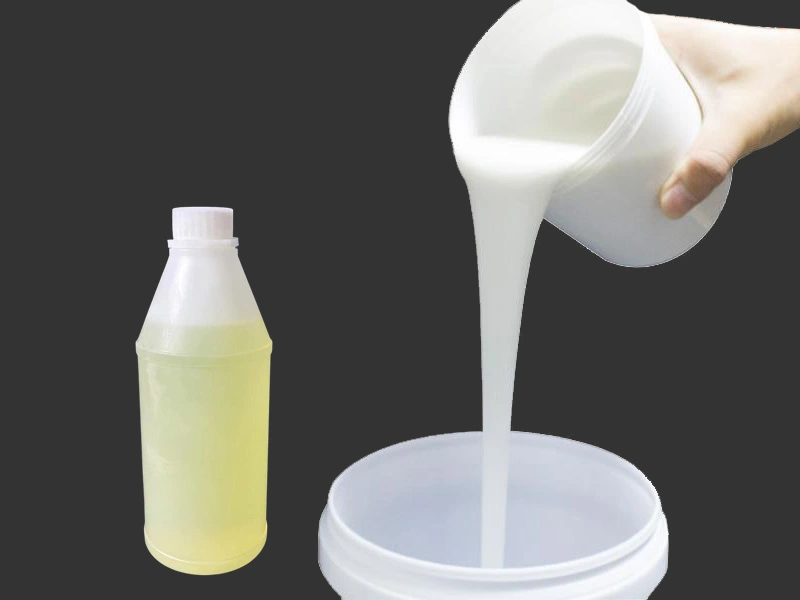
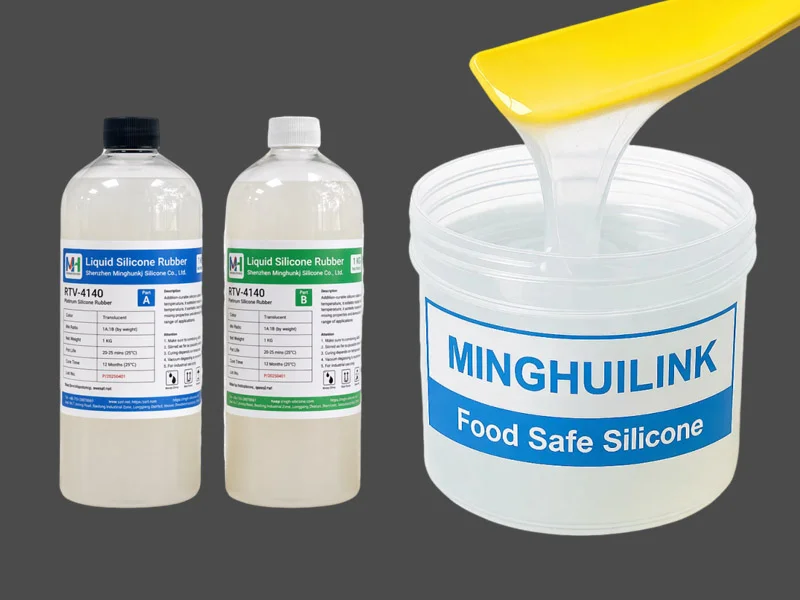 Food-grade liquid silicone
1. What Is Food-Grade Silicone?
Food-grade silicone generally refers to silicone rubber that has been formulated to meet specific food-contact regulatory requirements or has undergone a relevant compliance evaluation. It can be used to make molds, containers, baking tools, and other food-processing products that come into direct contact with food. However, its actual suitability depends on the product formulation, raw material composition, processing conditions, and applicable regulatory requirements.
Food-contact-grade silicone used for mold making is commonly supplied as a two-part RTV-2 liquid silicone system consisting of Part A and Part B. When the two components are mixed in the specified ratio, the material gradually cures through a crosslinking reaction to form an elastic silicone rubber.
Some food-contact-grade silicone products use a platinum-catalyzed addition-cure system. However, it is important to understand that platinum-cured silicone is not automatically food grade, and food-grade status cannot be determined solely by the use of a platinum catalyst. Whether a product is suitable for food contact must be verified based on its specific formulation, raw material composition, curing process, and intended conditions of use.
1.1 What Food-Contact Compliance Requirements Should You Check?
Different countries and regions have different regulatory requirements for food-contact materials. In the United States, one commonly referenced regulation is 21 CFR 177.2600, which applies to rubber articles intended for repeated use.
This regulation covers the composition and use restrictions of rubber articles. It also specifies requirements for different food-contact applications, including conditions for using raw materials, extraction limits for finished articles, and cleaning requirements before first use.
For silicone used to make food molds, particular attention should be paid to whether the specific product grade meets the applicable raw material requirements and whether the finished article satisfies the relevant food-contact conditions.
Test results should correspond to the specific product grade, final formulation, and specified curing process. A single extraction test result should not be interpreted as proof that the product complies with all food-contact requirements for every possible application.
It is also important to note that although 21 CFR 177.2600 lists silicone rubber base polymers that may be used in rubber articles, this does not mean that every silicone formulation automatically complies with the regulation. Other ingredients in the formulation, the extraction performance of the finished article, and the actual food-contact conditions must still meet the requirements of the applicable provisions.
1.2 What Is the Difference Between FDA Compliant and FDA Approved?
In the silicone industry, suppliers sometimes use terms such as FDA Compliant or FDA Approved. However, these terms should not be interpreted as meaning that the FDA has issued a universal food-grade certificate for a particular silicone product.
- FDA Compliant: This is generally a statement by a supplier or manufacturer that a product meets specific FDA regulatory requirements under defined conditions of use. It is not, by itself, a universal certification issued by the FDA.
- FDA Approved: This is not a universal approval designation for all food-contact materials. The FDA regulates or authorizes substances according to their identity and intended use through different pathways, including food additive regulations and Food Contact Substance Notifications (FCNs).
When purchasing food grade silicone, buyers should therefore verify the specific regulation or authorization supporting the supplier's claim, as well as the formulation, applicable food types, and conditions of use. The presence of the term FDA in product marketing materials is not sufficient to establish compliance.
For food mold making, it is advisable to request the technical data sheet, compliance declaration, and relevant test reports for the specific product grade. You should also verify the types of food and conditions of use covered by the documentation.
2. Key Advantages
2.1 Excellent Flexibility for Easy Food Release
One of the most practical advantages of food-contact-grade silicone is its elasticity and flexibility.
After curing, silicone can be bent and deformed to a certain extent. During demolding, the mold edges can be gently pulled back to help release finished products such as chocolates, candies, cake decorations, and other molded foods.
Compared with rigid molds, flexible silicone molds are particularly suitable for the following designs:
- Food molds with fine textures and embossed patterns.
- Molds featuring complex curved surfaces and decorative details.
- Food molds with grooves, undercuts, and irregular contours.
- Detailed molds where the finished product surface needs to remain intact.
This flexibility helps reduce compression and damage to finished products during demolding. It can also make handling more efficient in batch production.
However, mold hardness and flexibility need to be balanced according to the mold design. A mold that is too soft may not provide sufficient support, while a mold that is too hard may make it more difficult to release products with complex shapes.
2.2 Good Release Properties Help Preserve Product Details
Silicone has naturally good surface release properties, helping finished products separate from the mold cavity and reducing demolding difficulties with complex designs.
When making chocolates, candies, and cake decorations, molds often need to reproduce fine text, patterns, textures, and edges. A suitable silicone formulation can develop a smooth, detailed mold surface after curing, helping reproduce the features of the original master pattern.
Good release properties can also reduce the amount of food residue left inside the mold, making the mold easier to clean.
However, natural release properties do not guarantee that every type of food can be easily demolded under all conditions. Actual results are also affected by the food formulation, temperature, cooling process, mold surface quality, and mold design.
2.3 Suitable for Custom Shapes and Complex Food Mold Designs
Food-grade liquid silicone can be poured or brushed over master patterns of different shapes. Once cured, it forms a flexible mold that reproduces the master pattern.
This process means that mold designs are not limited to standard products. Custom food molds can be made to meet specific project requirements, including:
- Chocolate molds featuring brand logos and text.
- Custom candy and dessert decoration molds.
- Personalized cake decoration and baking molds.
- Butter and chocolate molds with special textures.
- Custom molds for ice cubes, ice sculptures, and refrigerated foods.
The ability to customize a mold mainly comes from the master pattern design and silicone molding process. The flow properties, flexibility, and curing performance of the silicone also affect how accurately the finished mold reproduces fine details.
For intricate designs, pay particular attention to the liquid silicone viscosity, working time, and vacuum degassing requirements to minimize the impact of air bubbles on the mold surface.
2.4 Suitable for Food Preparation at Different Temperatures
Depending on the specific formulation, food-grade silicone can be used for frozen products, room-temperature food preparation, and certain baking applications.
For example:
- Low-temperature applications: Molds for ice cubes, ice sculptures, and chilled desserts.
- Room-temperature applications: Molds for chocolates, candy decorations, and certain molded food products.
- High-temperature applications: Baking molds that meet the relevant temperature resistance requirements.
The heat resistance of silicone depends on its specific formulation. A material should not be considered suitable for high-temperature baking simply because it is classified as food-contact grade.
When selecting silicone for baking molds, check the following points:
- The maximum specified operating temperature.
- The continuous-use temperature and short-term temperature resistance.
- Performance stability after repeated heating and cooling cycles.
- Whether the product is approved for direct oven use under its specified conditions.
- Whether contact with open flames or use with the oven broiler/grill function is prohibited.
Pay particular attention to the fact that making high-temperature syrups and hard candies may involve relatively high pouring temperatures. Food-grade silicone suitable for chocolate or ice cube molds is not necessarily suitable for pouring hot candy mixtures.
Always follow the technical instructions for the specific product grade rather than applying temperature resistance data from other silicone products.
2.5 Reusable and Easy to Clean and Maintain
Food-contact-grade silicone molds can be reused when they are properly made, used, and maintained.
Compared with disposable molds, reusable silicone molds can meet the needs of multiple production batches. They are also suitable for applications where consistent product appearance is important.
Silicone molds are generally flexible enough to be bent slightly during cleaning, making it easier to remove food residues from the mold cavities.
However, there is no universal service life for silicone molds. Their actual lifespan is affected by several factors:
- Silicone hardness and tear strength.
- Mold wall thickness and structural design.
- Food formulation and processing temperature.
- Cleaning methods and frequency of use.
- Repeated heating, cooling, and demolding operations.
Therefore, when selecting mold making silicone, you should check not only food-contact compliance but also mechanical properties such as hardness, tear strength, tensile strength, and elongation at break.
3. Applications
Different foods have different requirements for mold materials. In addition to verifying food-contact suitability, you should select the appropriate silicone based on food composition, processing temperature, and molding method.
3.1 Chocolate and Butter Molds
Chocolate and butter are both fat-containing foods. When making molds for these applications, it is therefore essential to check whether the silicone is suitable for repeated contact with fatty foods.
Compliance for contact with dry or aqueous foods alone does not establish that a silicone product is also suitable for chocolate and butter.
In addition, chocolate molds generally require a high level of surface detail reproduction. For brand logos, text, decorative patterns, and intricate textures, choose a silicone formulation with suitable flow properties that produces a smooth, fine surface after curing.
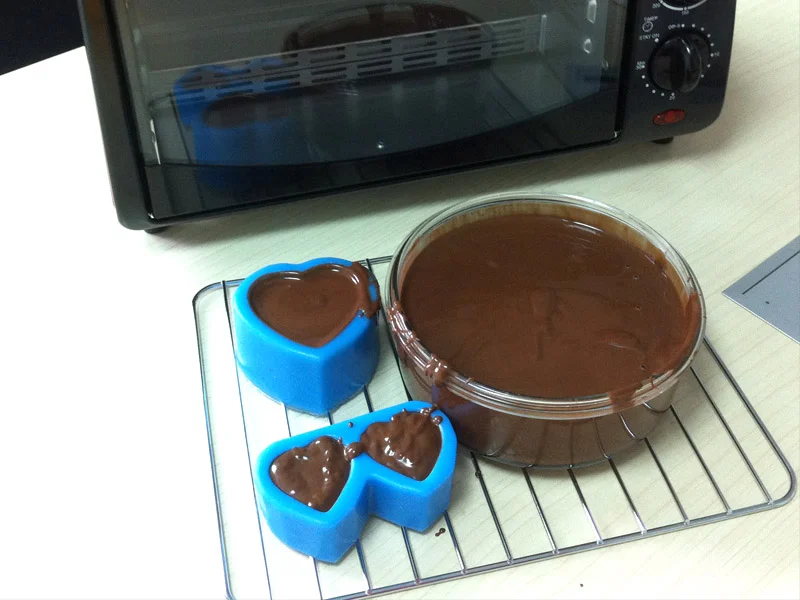 Chocolate silicone mold
3.2 Baking and Cake Molds
Food-grade silicone can be used to make certain cake molds, bread molds, baking trays, and other baking tools.
In addition to food-contact compliance, these applications require careful evaluation of the silicone's temperature resistance and suitability for oven use.
For flexible silicone baking molds, if permitted by the product instructions, place the mold on a flat baking tray before filling and moving it to improve handling stability.
For deep cavities or molds with complex shapes, consider how the food will heat during baking. Small-batch testing is recommended before the first use. Silicone does not guarantee completely even heating of food, so small-batch testing is also recommended for initial use.
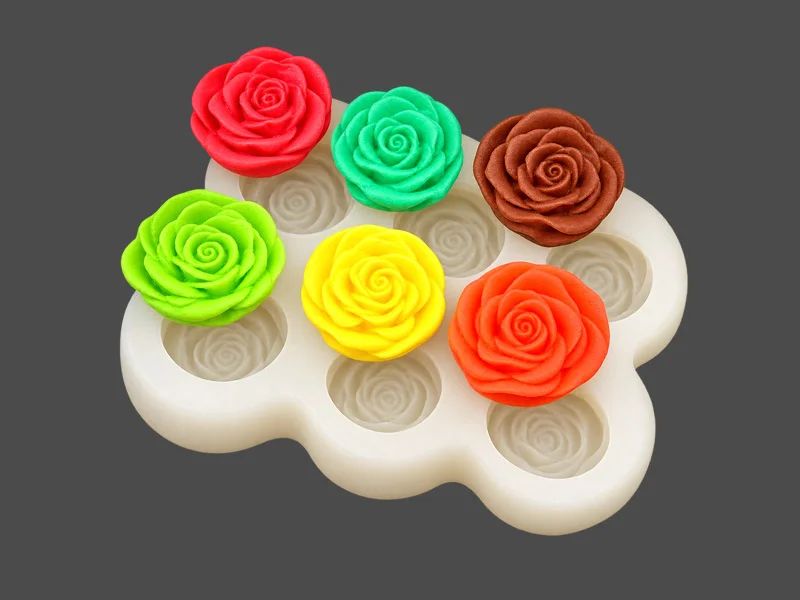 Cake silicone mold
3.3 Candy and Hard Candy Molds
Candy molds should be selected according to the specific production process.
Ordinary chocolate decorations and some candy-forming applications may involve relatively mild processing conditions, while hard candy production may require hot sugar syrup to be poured directly into the mold.
Therefore, food-contact compliance alone is not enough to determine whether a silicone mold is suitable for hard candy production. You must also verify the silicone's actual temperature resistance, contact time, and thermal cycling performance.
For hot syrup pouring, small-batch testing is recommended. Always follow the temperature limits specified by the silicone supplier.
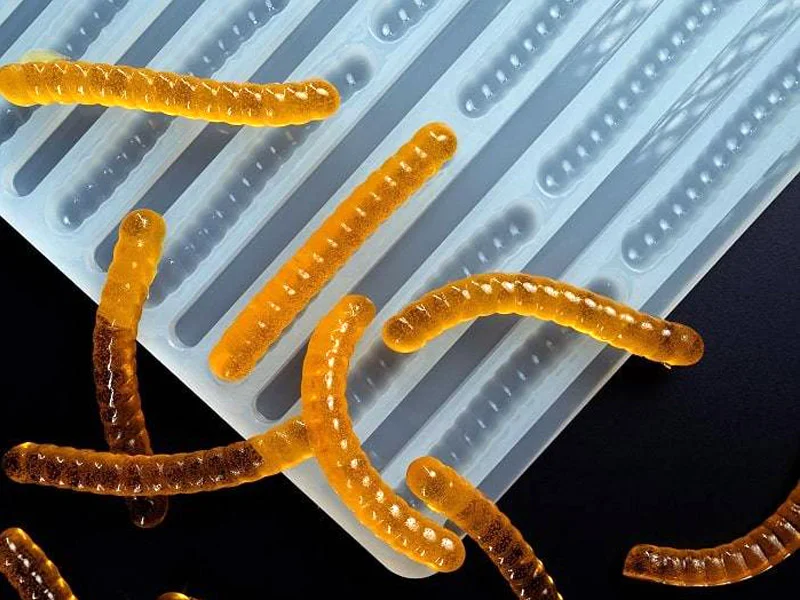 Candy silicone molds
3.4 Ice Cube and Refrigerated Food Molds
Food-contact-grade silicone can also be used to make molds for ice cubes, ice sculptures, chilled desserts, and other low-temperature applications.
The flexibility of silicone molds helps release frozen ice and food products, reducing the risk of damage caused by tapping or forcing the mold to bend.
However, a material suitable for making ice cube molds is not necessarily suitable for contact with fatty foods such as chocolate and butter. Food-contact requirements should be verified separately for each intended application.
4. How to Choose
Not every silicone product labeled as food grade is suitable for the same foods and processing methods. When purchasing food grade silicone, consider the following factors.
4.1 Confirm the Specific Food-Contact Application
This is the most important step when selecting food-grade silicone.
First, define the intended food-contact application of the mold. Then check the compliance declaration and test reports for the specific product grade to confirm that they cover the actual conditions of use.
For products intended for the U.S. market, check whether they comply with applicable FDA regulations, such as 21 CFR 177.2600. For the EU and other markets, evaluate the product against local food-contact regulations and its intended application.
4.2 Select Silicone Based on Operating Temperature
Different food production processes have different temperature requirements.
For ice cube molds, consider flexibility and release performance at low temperatures. For baking molds, verify suitability for high-temperature use. For hard candy molds, also consider brief contact with hot sugar syrup.
Check the temperature resistance data for the specific product rather than relying solely on the label "food-grade silicone."
4.3 Select Hardness Based on Mold Design
Silicone hardness affects both mold flexibility and support.
- Low-hardness silicone: Offers greater flexibility and is suitable for complex curved surfaces, detailed structures, and applications requiring greater deformation during demolding.
- Medium-hardness silicone: Provides a balance between flexibility and support, making it suitable for a wide range of food mold applications.
- Higher-hardness silicone: Generally offers better shape retention and is suitable for simpler mold cavities and applications that require more support.
Hardness alone does not represent all mechanical properties. For thin walls, narrow edges, and complex cavities, tear strength and elongation at break should also be considered.
4.4 Consider Viscosity, Working Time, and Detail Reproduction
The viscosity of liquid silicone affects the mixing, degassing, and pouring processes.
For master patterns with fine details or complex textures, a lower-viscosity formulation generally flows more easily into small features and helps air bubbles escape.
You should also check the following parameters:
- Mixed viscosity.
- Pot life.
- Cure time.
- Part A and Part B mix ratio.
- Whether the product is suitable for vacuum degassing.
- Whether it is suitable for pouring or brush-on molding processes.
During production, allow sufficient time for mixing, degassing, and pouring based on the mold size and production schedule.
4.5 Check Test Reports and Processing Instructions
When purchasing food-contact-grade silicone, it is advisable to request the following documents from the supplier:
- Technical Data Sheet (TDS).
- Safety Data Sheet (SDS).
- Applicable food-contact compliance declaration.
- Relevant third-party test reports.
- Specific instructions for mixing, curing, and post-curing.
Please note that an SDS primarily provides information about product safety and handling. It cannot, on its own, serve as proof of food-contact compliance.
If the product requires post-curing, follow the temperature and time specified by the supplier. Do not skip a post-curing step explicitly required for the selected product grade simply because other food-grade silicone products do not require it.
In addition, when using pigments, release agents, or other additives, verify that they will not compromise compliance for the final food-contact application.
5. Important Considerations
Selecting the right material is only one part of making food molds. The manufacturing process and subsequent maintenance are equally important.
5.1 Check Compatibility Between the Master Pattern and Silicone
If you use RTV-2 platinum-cured silicone to make food molds, pay particular attention to the risk of cure inhibition.
Certain sulfur-containing materials, amine compounds, tin compounds, some coatings and adhesives, and inadequately processed 3D-printed materials may interfere with the curing of addition-cured silicone.
Before full-scale production, it is advisable to carry out a small-area curing test using the master pattern material, surface treatment agents, and other materials that will come into contact with the silicone.
If you need to use sealants, pigments, or release agents, also verify their compatibility with the silicone formulation and the intended food-contact application.
5.2 Mix at the Specified Ratio and Allow the Silicone to Cure Fully
Two-part food-contact-grade liquid silicone generally requires Part A and Part B to be mixed in a specified ratio.
Mix ratios vary between product grades and may be specified by weight or by volume. Always follow the product TDS and do not confuse these two measurement methods.
Insufficient mixing, an incorrect mix ratio, or improper curing conditions may prevent the material from curing fully and affect the performance of the finished mold.
5.3 Follow the Specified Degassing and Post-Curing Procedures
For food molds, surface bubbles can affect not only the appearance of finished products but also mold detail reproduction and cleaning performance.
When permitted by the product instructions, vacuum degassing can be used to reduce air bubbles introduced during mixing.
Some food-contact-grade silicone products also require a specified post-curing process to meet their particular application requirements. Post-curing is not a universal requirement for all products. Always follow the technical instructions and compliance documentation for the specific product grade.
5.4 Clean Thoroughly Before First Use
Before coming into contact with food for the first time, food-contact-grade silicone molds should be cleaned thoroughly in accordance with applicable regulations and product instructions.
For example, 21 CFR 177.2600(g) requires finished rubber articles intended for repeated food contact to be thoroughly cleaned before their first use.
For routine maintenance, use suitable cleaning agents, warm water, and soft cleaning tools as recommended by the supplier. Rinse thoroughly and allow the mold to dry completely.
Do not assume that all silicone molds are suitable for dishwashers, strongly acidic or alkaline cleaners, or high-temperature sterilization. The appropriate cleaning method depends on the specific product instructions.
5.5 Keep Food Molds Separate from Molds Used for Non-Food Applications
Silicone molds used for food preparation should be managed separately from molds used for resin, plaster, industrial wax, and other non-food applications.
Molds that have come into contact with non-food-grade resins, industrial pigments, or non-food-contact release agents should not be used for food preparation without appropriate validation. Residual substances may compromise food-contact safety.
We recommend clearly labeling food-contact molds and inspecting them regularly for tears, deformation, surface damage, or residue that is difficult to remove.
6. FAQs
- Q1: What Is the Difference Between Food-Grade Silicone and Regular Silicone?
-
The main differences lie in formulation design, raw material composition, and suitability for food-contact applications.
Regular silicone does not necessarily meet food-contact requirements. Food-contact-grade silicone must be evaluated against the regulations of the target market and the specific conditions of use, with relevant technical documents or test reports provided where applicable.
- Q2: Is Food-Grade Silicone Suitable for All Types of Food Preparation?
-
No. Food-contact suitability depends on the specific product formulation, test results, and specified conditions of use. Before purchasing, check whether the product documentation covers the actual food types and processing methods involved. Do not rely on the food-grade label alone to determine suitability.
- Q3: Can All Food-Grade Silicone Products Be Used in an Oven?
-
No. Food-contact compliance and high-temperature resistance are two separate criteria.
When making baking molds, verify whether the specific product grade is suitable for oven use. Check its maximum operating temperature, heating time, and whether use with the broiler or grill function is prohibited.
- Q4: Does Food-Grade Silicone Need Post-Curing After Mold Making?
-
Whether post-curing is required depends on the specific product formulation and compliance requirements.
If the supplier's technical instructions specify a post-curing temperature and duration, follow them carefully. Do not apply the post-curing procedure for one product grade directly to a different product.
- Q5: Is All Food-Grade Silicone Platinum-Cured Silicone?
-
No. Food-contact suitability is not determined by the curing system alone.
Some silicone products designed for food molds use a platinum-catalyzed addition-cure system. However, their suitability for food contact still depends on the specific formulation, raw material composition, curing process, and applicable regulatory requirements.
- Q6: Do Food-Grade Silicone Molds Need a Release Agent?
-
Not necessarily. Silicone naturally has good release properties, and many food molds can be demolded directly under suitable cooling and handling conditions.
However, if a release agent is needed, verify that it is suitable for food-contact applications and meets the relevant regulatory and product requirements. Do not substitute an ordinary industrial release agent for a product specifically intended for food-contact use.
- Q7: How Long Can Food-Grade Silicone Molds Be Reused?
-
There is no single service life that applies to all food-grade silicone molds.
Actual lifespan depends on the silicone formulation, hardness, tear resistance, mold design, food processing temperature, and routine cleaning methods. Inspect molds regularly for cracks, damage, deformation, or other issues that may affect food-contact safety and molding performance.
7. Conclusion
With its excellent flexibility, release properties, detail reproduction, and customization options, food-grade silicone is an important material choice for baking molds, chocolate molds, candy molds, and other food-forming tools.
However, food-grade status does not mean that every silicone product is suitable for all foods or processing environments. Food-contact suitability, temperature requirements, hardness, viscosity, mechanical properties, and curing procedures all affect the performance of the finished mold.
When selecting food-grade silicone, first identify the actual food types and processing conditions. Then verify the compliance documents, test reports, and technical data for the specific product grade. Matching the silicone formulation and mold design to the intended application is essential for producing molds suitable for their intended food-contact use.



We value your comments, but please refrain from posting meaningless or irrelevant content. Kindly review our Comment Policy before commenting.