Casting silicone in a silicone mold is a common silicone rubber molding process used to produce flexible parts, silicone models, prototype replicas, and other elastic silicone products. Unlike conventional casting processes in which resin, wax, or plaster is poured into a silicone mold, casting silicone into a silicone mold requires special attention to material bonding and curing compatibility when the casting material is also silicone.
Silicone rubber generally offers good release properties, but this does not mean that newly poured liquid silicone will automatically separate from an already cured silicone mold. When uncured liquid silicone comes into contact with a cured silicone mold, material bonding or cure inhibition may occur. Bonding can make demolding difficult, while cure inhibition may prevent the casting material from curing completely at the contact interface. The actual outcome depends on the curing systems and formulation compatibility of the mold and casting materials.
Therefore, before casting, it is important to select an appropriate silicone mold release agent, confirm that the mold and casting materials have compatible curing systems, and follow the product instructions for mixing, degassing, and curing.
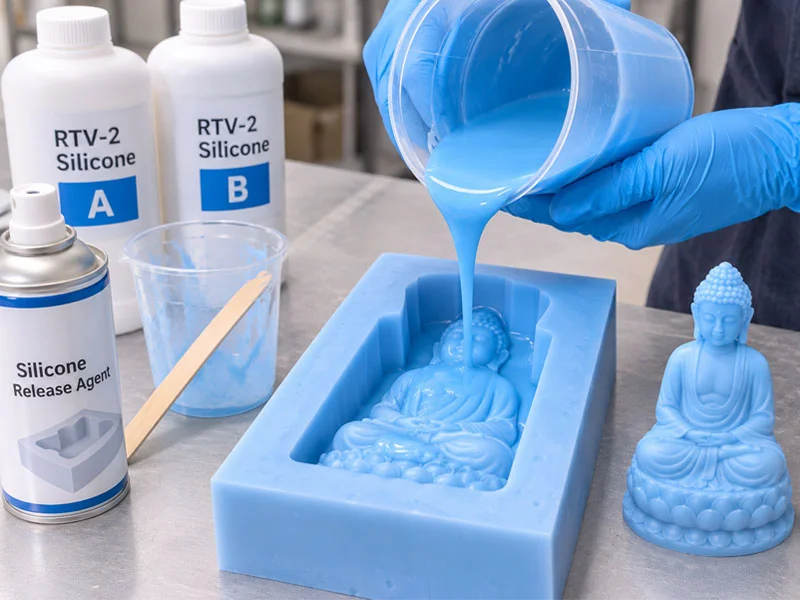 Pouring Liquid Silicone into a Silicone Mold
1. Can You Cast Silicone in a Silicone Mold?
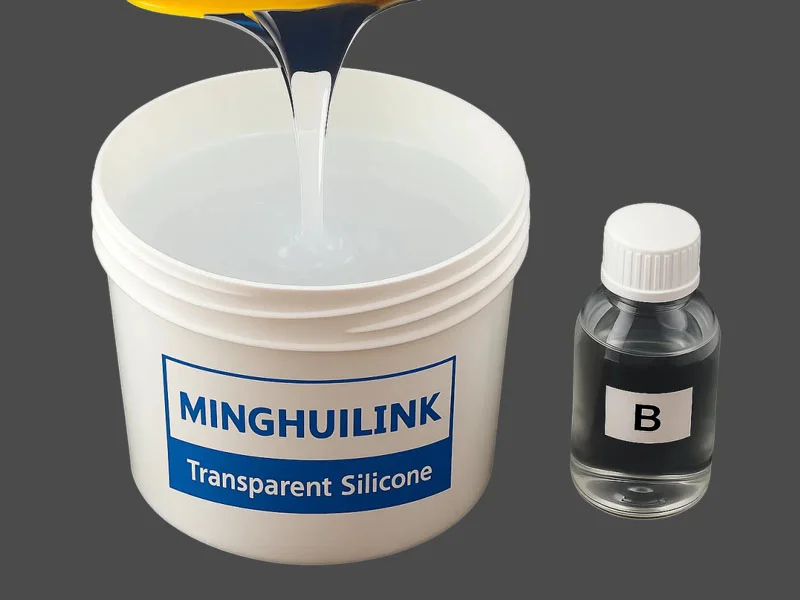
Yes. By using suitable two-component RTV-2 liquid silicone rubber and a specialized mold release agent, new silicone material can be poured into an already cured silicone mold and removed after curing to produce a separate silicone part.
This process is commonly used for the following applications:
- Making flexible silicone parts and elastic models.
- Replicating lifelike models, sculptures, and objects with special shapes.
- Producing silicone props, realistic models, and special effects components.
- Manufacturing flexible prototypes and small-batch silicone products.
- Making silicone parts that combine different hardness levels or colors.
However, it is important to understand that the natural release properties of a silicone mold do not mean it will automatically separate from newly poured silicone.
For example, epoxy resin and some polyurethane resins can generally be released relatively easily from silicone molds. Newly poured liquid silicone, however, may bond to the surface of an already cured silicone mold. Therefore, casting silicone in a silicone mold usually requires a dedicated release treatment.
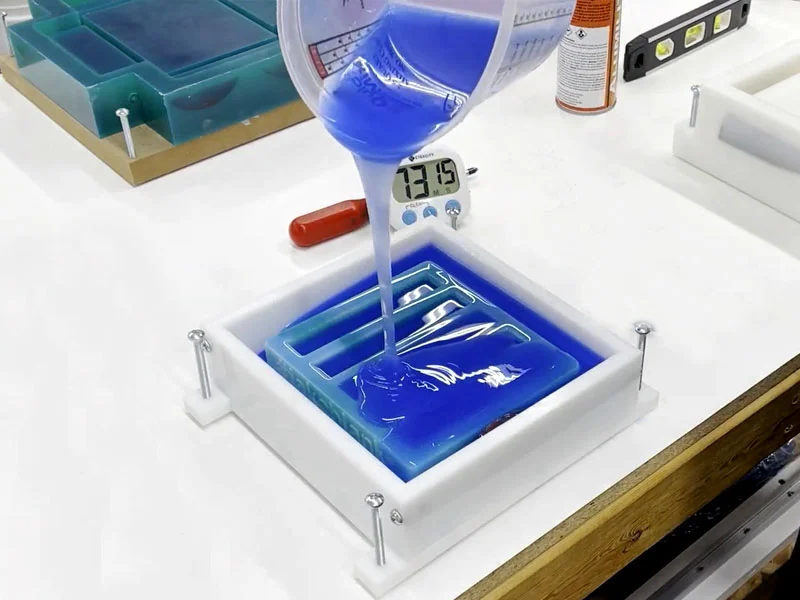 Pouring Liquid Silicone into a Mold
2. Why Does Silicone Bond to a Silicone Mold During Casting?
Silicone rubber offers good flexibility and release properties, but its surface is not completely non-stick to every material.
When uncured liquid silicone comes into direct contact with a cured silicone surface, the two materials may adhere to each other and form an interface that is difficult to separate.
The most common causes include the following.
2.1 Silicone Materials Can Bond to Each Other
Before curing, liquid silicone has a certain degree of flowability, allowing it to make close contact with the surface of a cured silicone mold.
Because both materials are silicone rubber, the uncured material may adhere strongly to the cured mold surface. Without a suitable barrier layer, the cured casting may stick to the mold.
In some cases, the two silicone materials may be difficult to separate cleanly. Forcing demolding can even cause the mold or casting to tear.
Therefore, when the goal is to produce a separate silicone part that can be removed from the mold, an appropriate release agent designed for silicone-to-silicone applications should be used before casting.
2.2 Improper Use of Mold Release Agents
The main purpose of a mold release agent is to form a barrier between the mold and the casting material. This reduces direct contact between the two materials and makes subsequent demolding easier.
However, sticking may still occur under the following conditions:
- No mold release agent is used.
- The release agent is not suitable for silicone-to-silicone casting.
- Some areas of the mold surface are left uncovered.
- The release coating is uneven or too thin in certain areas.
- Too much release agent is applied, resulting in pooling or visible surface texture.
Therefore, it is important not only to choose the correct release agent but also to apply it evenly according to the product instructions.
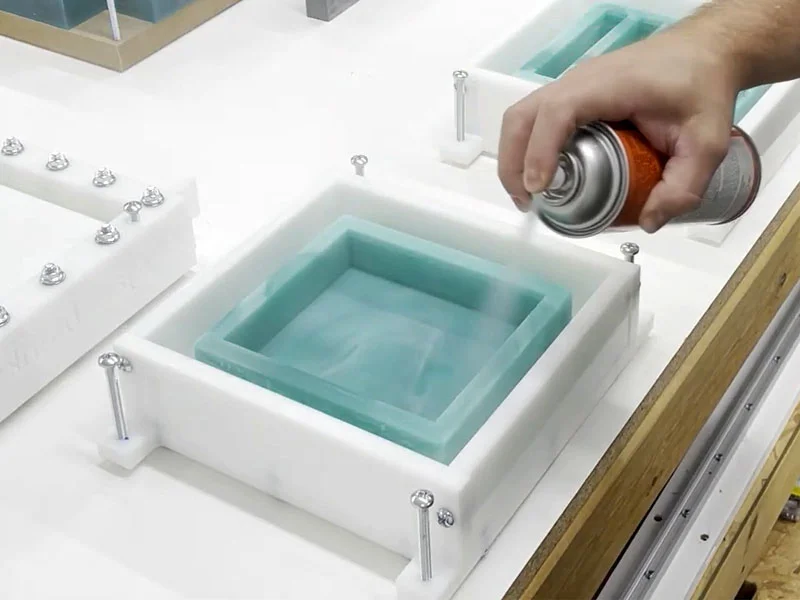 Spraying Mold Release Agent onto a Silicone Mold
2.3 Compatibility Issues Between Different Silicone Curing Systems
In addition to physical bonding, different silicone curing systems may also have chemical compatibility issues.
Particular attention should be paid to combinations of tin-cure and platinum-cure silicone.
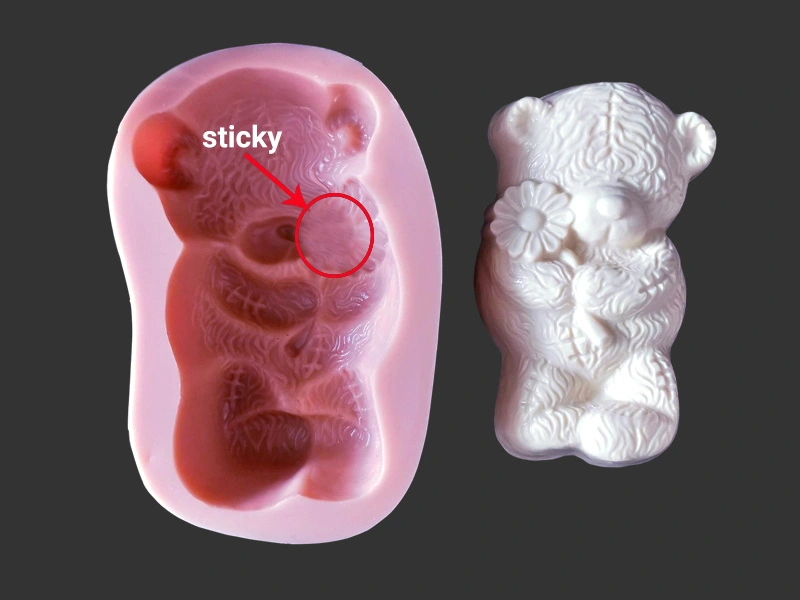
Some condensation-cure and addition-cure silicone formulations may cause interfacial cure inhibition when they come into direct contact. As a result, the casting material may fail to cure properly in the areas touching the mold, leaving a tacky surface or locally uncured sections. Such problems may be related to incompatibility between different formulations or the presence of residual substances. The specific cause should be assessed using the technical information for the products involved.
Therefore, the fact that both the mold and casting material are silicone rubber does not automatically mean they are compatible. For combinations involving different curing systems, compatibility should be confirmed in advance and tested on a small scale.
3. Compatibility Between Silicone Molds and Casting Silicone
When pouring new liquid silicone into a silicone mold, both the curing system of the mold and that of the casting material should be considered.
This is particularly important when using platinum-cure, addition-cure silicone, as potential contaminants on the mold surface may interfere with the catalytic reaction.
3.1 Casting Platinum-Cure Silicone in a Tin-Cure Silicone Mold
This material combination requires particular caution.
Tin-cure silicone belongs to the condensation-cure system, while platinum-cure silicone belongs to the addition-cure system.
When certain tin-cure silicone formulations come into direct contact with platinum-cure, addition-cure silicone, interfacial cure inhibition may occur, preventing the newly poured platinum silicone from curing properly. The actual risk depends on the material formulations and compatibility at the contact interface. It should not be attributed simply to the presence of a particular residual tin compound.
Possible symptoms include:
- The surface in contact with the mold remains tacky.
- Some areas fail to cure completely.
- Localized soft or uncured areas appear after demolding.
- The surface quality and mechanical properties of the finished part do not meet expectations.
Therefore, pouring platinum-cure, addition-cure silicone directly into a tin-cure silicone mold is not recommended without prior compatibility verification.
If this combination is necessary for a project, confirm compatibility with the material suppliers and conduct a small-scale curing test first. An ordinary mold release agent should not be regarded as a reliable guarantee against cure inhibition.
3.2 Casting Platinum-Cure Silicone in a Platinum-Cure Silicone Mold
Using a platinum-cure silicone mold to cast new platinum-cure silicone is generally easier to manage in terms of material system compatibility.
However, the two materials may still bond to each other.
Therefore, even when both the mold and casting material are addition-cure silicone, mold release treatment should not be skipped.
Choose a silicone mold release agent suitable for the specific platinum-cure silicone formulation, and confirm that it will not interfere with the curing of the newly poured material.
3.3 Casting Tin-Cure Silicone in a Platinum-Cure Silicone Mold
Casting tin-cure, condensation-cure silicone in a platinum-cure silicone mold also requires attention to interfacial curing compatibility. Some condensation-cure and addition-cure silicone formulations may cause cure inhibition when they come into direct contact. Therefore, the risk is not limited to casting platinum-cure silicone in a tin-cure silicone mold. Material compatibility should be tested before production.
3.4 Considerations for Different Silicone Combinations
| Silicone Mold Type | Casting Silicone Type | Key Considerations |
|---|---|---|
| Tin-cure (condensation-cure) | Tin-cure (condensation-cure) | Use a suitable mold release agent and verify product compatibility. |
| Platinum-cure (addition-cure) | Platinum-cure (addition-cure) | Use a mold release agent specifically designed for silicone-to-silicone applications. |
| Tin-cure (condensation-cure) | Platinum-cure (addition-cure) | Interfacial cure inhibition is possible; use particular caution. |
| Platinum-cure (addition-cure) | Tin-cure (condensation-cure) | Interfacial cure inhibition is also possible; testing is required in advance. |
Please note that the table summarizes general material selection principles. It does not mean that products from all brands or formulations can be used together in these combinations without testing. Always refer to the technical information provided by the mold and casting material manufacturers and confirm compatibility through testing.
4. How to Choose the Right Silicone Mold Release Agent
When casting silicone in a silicone mold, the mold release agent is an important factor affecting the quality of the finished part.
A release agent used for conventional resin casting is not necessarily suitable for silicone-to-silicone casting. It is recommended to choose a specialized product explicitly designed to release silicone rubber from silicone rubber.
4.1 Choose a Specialized Silicone Mold Release Agent
When selecting a product, pay particular attention to the following:
- Whether it is specifically recommended for pouring liquid silicone into an already cured silicone mold.
- Whether it is compatible with tin-cure and platinum-cure silicone systems.
- Whether it may interfere with the curing of the newly poured silicone.
- Whether it can form a thin, uniform barrier layer.
- Whether it may affect fine surface details or the appearance of the finished part.
- Whether any release agent residue may affect subsequent cleaning, bonding, or painting.
Release agent formulations and recommended applications vary between manufacturers. Some specialized products specify limits on silicone oil content, while others are specifically formulated and labeled for casting liquid silicone into cured silicone molds. Therefore, suitability should not be judged solely by whether a release agent contains silicone oil. Always refer to the technical information for the specific product and confirm its performance through practical testing.
4.2 Apply the Mold Release Agent Evenly
The release agent should cover as much of the mold surface as possible wherever it will come into contact with the newly poured silicone. Pay particular attention to complex curved surfaces, deep grooves, undercuts, and narrow sections.
General application guidelines include:
- Spray or apply a thin, even coat of release agent to the mold surface according to the product instructions.
- If necessary, use a clean, soft brush to help distribute the release agent across complex areas.
- Check for missed areas, pooling, or visible buildup of the coating.
- Follow the release agent instructions to determine whether time is needed for solvent evaporation or the coating to dry.
- Proceed with silicone casting only after the surface treatment is complete.
Do not assume that applying a thicker layer of release agent will produce better release performance. An excessively thick coating may affect the reproduction of fine mold details and leave unwanted surface texture on the finished part.
4.3 Why Is Small-Scale Testing Recommended?
Even when a release agent is explicitly labeled as suitable for silicone molds, it cannot be assumed to be fully compatible with every silicone formulation.
It is recommended to test a small amount of casting material in a non-critical area of the mold or in a test mold to verify the following:
- Whether the release agent forms an effective barrier layer.
- Whether the newly poured silicone cures completely.
- Whether the cured part can be demolded smoothly.
- Whether the finished surface shows oil residue, unwanted texture, or other defects.
Proceed with full production only after confirming that the material combination and release process meet the project requirements.
5. Step-by-Step Guide to Casting Silicone in a Silicone Mold
Following the correct procedure not only helps reduce sticking but can also improve the surface quality and dimensional consistency of the finished part.
5.1 Inspect and Clean the Silicone Mold
Before casting, check whether the mold is fully cured and whether its surface contains dust, residual silicone, oil, or buildup left by previously used release agents.
Pay particular attention to the following:
- Whether the mold surface is intact.
- Whether the parting surface is flat and even.
- Whether the gates and venting channels are clear.
- Whether any previous casting material remains inside the mold.
- Whether the mold has any damage or localized deformation.
If the mold has not reached the required state of cure, it is not recommended to proceed immediately with another casting cycle.
When cleaning, use a method compatible with the mold material. Avoid untested solvents that may affect the silicone surface or leave incompatible residues.
5.2 Apply a Silicone-Specific Mold Release Agent
After confirming that the mold is clean and dry, spray or brush on the release agent according to its instructions.
Pay particular attention to deep grooves, undercuts, and easily overlooked corners to ensure that all contact areas receive adequate coverage.
For a two-part mold, inspect the contact areas on both mold halves and treat the parting surfaces according to the actual mold design.
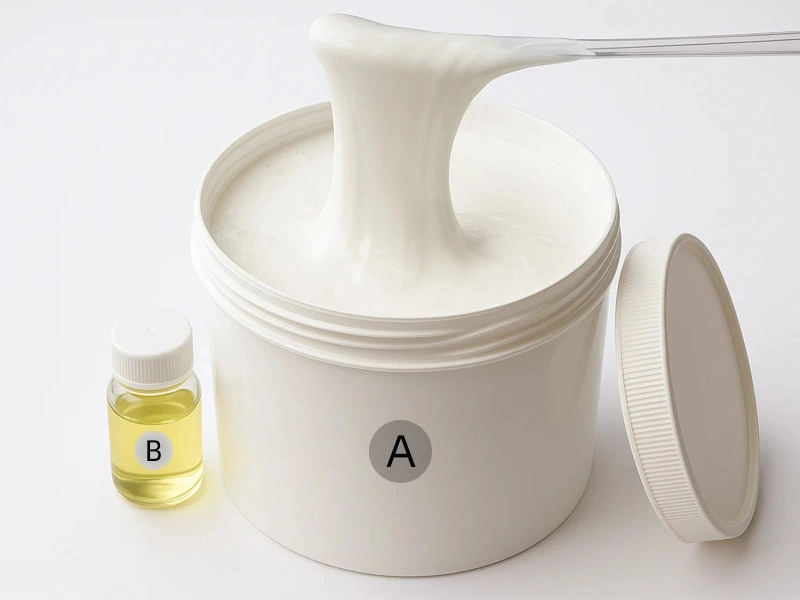
5.3 Accurately Measure and Mix Parts A and B
For two-component RTV-2 liquid silicone rubber, measure Parts A and B accurately according to the weight ratio or volume ratio specified by the manufacturer.
During mixing, pay attention to the following:
- Use an accurate electronic scale or suitable measuring equipment.
- Pre-mix each component if required by the product instructions.
- Mix thoroughly to avoid leaving unmixed material at the bottom or along the sides of the container.
- Do not arbitrarily change the mixing ratio of Parts A and B.
- Control the mixing time and avoid exceeding the specified working time.
Different RTV-2 products may have mixing ratios such as 1:1, 10:1, or other proportions. Parts A and B from different products must not be mixed together simply because they have the same component configuration.
5.4 Vacuum Degas When Necessary
Air can easily become trapped in liquid silicone during mixing. This is particularly common with high-viscosity silicone, in which bubbles may not escape naturally.
If vacuum degassing equipment is required by the product or process, select suitable degassing conditions based on the material viscosity, container capacity, and available processing time.
Leave sufficient space in the container during degassing to prevent the silicone from expanding and overflowing.
For products with a short working time, the sequence of measuring, mixing, degassing, and pouring should also be planned carefully to prevent the material from becoming noticeably thicker before casting.
5.5 Pour the Liquid Silicone Slowly
During pouring, choose a suitable pouring position and method according to the mold structure.
Recommended practices include:
- Whenever possible, pour from a lower point of the mold or through a designated gate.
- Maintain a continuous, slow pouring flow.
- Avoid pouring a large amount of material too quickly, which may trap air.
- Provide suitable venting channels for complex mold structures.
- Check that the silicone completely fills deep grooves, fine details, and undercut areas.
For enclosed or two-part silicone molds, ensure that the parting surfaces fit together properly. Use suitable clamps or support structures to reduce the risk of leakage or mold deformation during pouring.
5.6 Allow the Silicone to Cure and Demold According to the Product Instructions
After pouring, allow the silicone to cure under the recommended temperature and time conditions.
The curing speed of RTV-2 silicone depends on the specific formulation, ambient temperature, mixing ratio, and processing conditions specified for the product.
Do not assume that the material has reached its final properties simply because the surface is no longer tacky or the casting has initially taken shape.
Once the specified demolding time has been reached, separate the mold carefully. Avoid pulling directly on thin walls, sharp corners, or delicate structures of the finished part.
If noticeable sticking occurs, stop forcing the part out of the mold. Check the release agent coverage and material compatibility to avoid further damage to the mold.
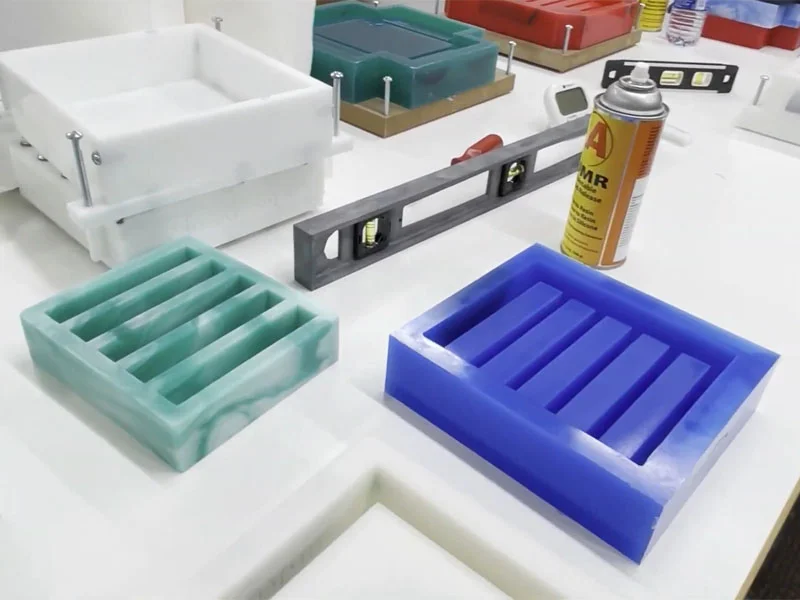 Silicone Castings Demolded from Silicone Molds
6. How to Choose the Right RTV-2 Liquid Silicone for Casting in a Silicone Mold
When selecting a casting material, consider not only whether it can be released from the mold but also the performance requirements of the final silicone product.
6.1 Choose the Hardness Based on the Finished Product Requirements
Shore A hardness is an important property of RTV-2 silicone. It affects the softness, flexibility, and shape-retention ability of the finished product.
In general:
- Soft silicone: Offers greater softness and flexibility, making it suitable for products requiring a flexible feel or a high degree of deformation.
- Medium-hardness silicone: Provides a balance between flexibility and support, making it suitable for many general-purpose silicone parts.
- Hard silicone: Generally offers better support and shape retention, making it suitable for products that require greater structural stability.
It is important to note that the hardness of the finished product is determined by the casting silicone itself, not by the hardness of the original mold.
6.2 Choose the Material Based on Viscosity and Flowability
The viscosity of liquid silicone affects pouring efficiency and its ability to fill complex mold cavities.
If the mold contains many fine grooves, deep holes, or complex curved surfaces, consider a product with suitable flowability so that the material can fill all areas adequately.
For higher-viscosity silicone, evaluate whether the available vacuum degassing capability and pouring equipment are suitable for the process requirements.
6.3 Choose the Material Based on Tear Strength and Elongation
If the finished silicone product needs to withstand repeated stretching, bending, or mechanical loads, pay particular attention to the following properties:
- Tear Strength.
- Tensile Strength.
- Elongation at Break.
Different applications require different mechanical properties. For example, the silicone performance requirements for flexible lifelike models are not necessarily the same as those for industrial parts that need a certain degree of structural support.
6.4 Choose the Material Based on Its Curing System
RTV-2 silicone mainly includes two curing systems: condensation-cure and addition-cure.
When selecting a casting material, confirm its compatibility with the existing silicone mold. Pay particular attention to the risk of cross-system cure inhibition between tin-cure, condensation-cure silicone and platinum-cure, addition-cure silicone. Whether a tin-cure mold is used with platinum-cure casting silicone or a platinum-cure mold is used with tin-cure casting silicone, do not assume that the material will cure properly. Prioritize the manufacturer's compatibility information and conduct a small-scale test.
7. Common Problems and Solutions
Common problems when casting silicone in a silicone mold include sticking, incomplete curing, air bubbles, and surface defects on the finished part.
| Common Problem | Possible Cause | Recommended Solution |
|---|---|---|
| Silicone sticks to the mold | No release agent was used, or coverage was uneven. | Use a specialized silicone mold release agent and check its coverage. |
| The finished part cannot be separated from the mold | The release agent is ineffective, coverage is uneven, or the two silicone materials have bonded. | Check the suitability and application of the release agent, as well as material compatibility. |
| The surface of the finished part remains tacky | Cure inhibition, an incorrect mixing ratio, or insufficient mixing. | Check the curing systems, potential sources of contamination, and mixing ratio. |
| Some areas fail to cure | The mold and casting silicone are incompatible. | Check compatibility between tin-cure and platinum-cure systems. |
| Air bubbles remain inside the finished part | Improper mixing, degassing, or pouring procedures. | Optimize vacuum degassing and the pouring process. |
| Texture or defects appear on the finished surface | The release agent was applied too thickly or unevenly. | Control the amount of release agent and improve application uniformity. |
| The mold tears during demolding | Improper demolding, complex undercut structures, or insufficient tear strength. | Adjust the demolding method and optimize the mold material. |
7.1 Why Can't a Silicone Mold Release Agent Solve Every Curing Problem?
A mold release agent is primarily used to reduce bonding between the mold and the casting material. It cannot guarantee that two different curing systems will be compatible.
For example, if platinum-cure, addition-cure silicone comes into contact with a substance that may inhibit the platinum-catalyzed reaction, applying a release agent to the surface does not automatically guarantee that the casting material will cure properly.
Therefore, mold release treatment and material compatibility checks are two separate steps and cannot replace each other.
8. Frequently Asked Questions (FAQ)
- Q1: Can liquid silicone be poured directly into an already cured silicone mold?
- Yes, but particular attention must be paid to the possibility of bonding between the two silicone materials. A specialized mold release agent suitable for silicone-to-silicone applications should generally be used, and the curing systems of the mold and casting material must be confirmed as compatible.
- Q2: Is a mold release agent necessary when casting silicone in a silicone mold?
- Usually, yes. Silicone materials may bond or fuse to each other, so it is recommended to use a tested silicone-specific mold release agent before casting and apply it evenly to all contact areas.
- Q3: Can tin-cure silicone and platinum-cure silicone be cast against each other?
- Particular caution is required. Direct contact between tin-cure, condensation-cure silicone and platinum-cure, addition-cure silicone may cause interfacial cure inhibition. Neither material should be assumed to cure properly against the other, regardless of which one is used for the mold. Before production, confirm compatibility between the two products and conduct a small-scale curing test. A specialized mold release agent can help prevent material bonding, but it does not guarantee that cure inhibition will be eliminated.
- Q4: Can a platinum-cure silicone mold be used to cast new platinum-cure silicone?
- Generally, yes. However, a mold release agent suitable for silicone-to-silicone applications is still required to prevent the two silicone materials from bonding. Compatibility between the specific formulations should also be confirmed in advance.
- Q5: Can silicone with a different hardness be cast in a silicone mold?
- Yes. The hardness of the casting material is determined by the silicone formulation used and does not need to match the hardness of the mold. However, material compatibility, the structure of the finished part, and the demolding method should also be considered.
- Q6: Can a silicone mold be reused for repeated silicone casting?
- Generally, yes. However, the service life of the mold depends on the tear strength of the silicone material, the mold structure, the casting material, and the demolding procedure. After each production cycle, inspect the mold surface, clean away any residue, and reapply mold release agent according to the process requirements.
- Q7: Why do some areas remain uncured when casting silicone in a silicone mold?
- Possible causes include cure inhibition, an incorrect mixing ratio of Parts A and B, or insufficient mixing. With platinum-cure, addition-cure silicone in particular, pay attention to tin compounds, sulfur compounds, and other contaminants on the mold surface that may interfere with the catalytic reaction.
- Q8: What is the difference between casting resin and casting silicone in a silicone mold?
- Resin and silicone have different material properties and release requirements. Materials such as epoxy resin and some polyurethane resins can generally be cast using the natural release properties of silicone molds, although the actual result depends on the type of resin. When silicone is cast into a silicone mold, material bonding is more likely to occur, so a specialized silicone mold release agent is usually required.
9. Conclusion
Casting silicone in a silicone mold is a practical process for manufacturing elastic products. It is suitable for producing flexible parts, silicone models, prototype replicas, and other silicone rubber products.
Unlike conventional resin casting, silicone-to-silicone casting requires particular attention to material bonding, mold release agent selection, and curing system compatibility.
To achieve consistent product quality, confirm the compatibility of the mold and casting material before production, select a suitable silicone-specific mold release agent, and carefully control the mixing ratio of Parts A and B, mixing, degassing, and curing conditions.
Properly managing these steps can help reduce sticking and curing failures, improve the surface quality of the finished product, and extend the service life of the silicone mold.

We value your comments, but please refrain from posting meaningless or irrelevant content. Kindly review our Comment Policy before commenting.