Transparent liquid silicone (Transparent RTV-2 Silicone) is a two-component liquid silicone rubber with good optical clarity. After Parts A and B are mixed at the specified ratio and cured, the material forms flexible and durable silicone molds. Compared with opaque silicone, its main advantage is the ability to see the master pattern or mold cavity structure through the mold, making mold cutting, pattern positioning, and inspection during casting easier.
Transparent mold-making silicone is particularly suitable for jewelry making, precision prototype replication, resin casting, and rapid prototyping. When making complex one-piece cut block molds, transparency helps identify the position and shape of the master pattern, allowing more accurate planning of the cutting path. However, transparency does not necessarily mean that the material has higher mechanical strength or better detail reproduction. Actual performance still depends on the silicone formulation, hardness, tear strength, viscosity, and processing conditions.
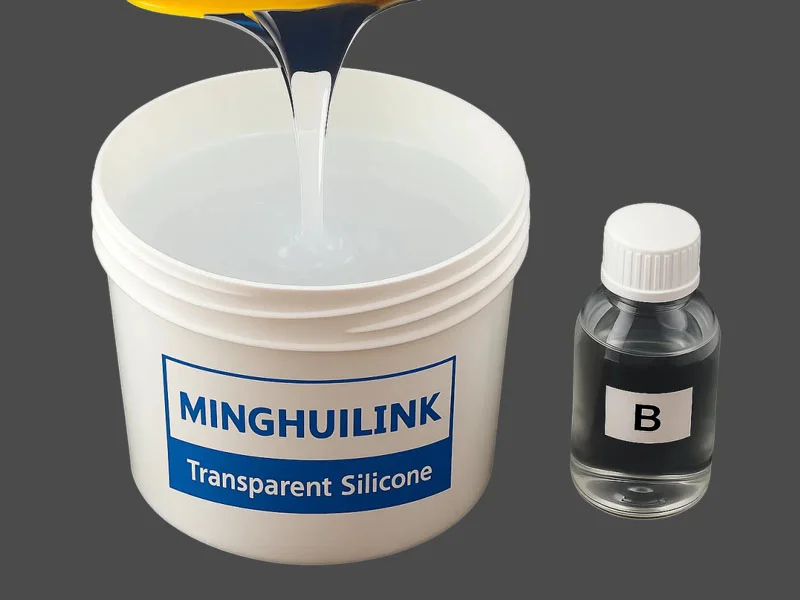 Transparent Liquid Silicone
1. Key Benefits of Transparent Mold-Making Silicone
The greatest value of transparent mold-making silicone lies in its visibility, while retaining the flexibility, detail reproduction capability, and release properties of silicone rubber.
1.1 Improved Master Pattern Visibility and More Accurate Cutting Paths
Transparent silicone is particularly suitable for making one-piece cut block molds.
When producing this type of mold, one or more cuts are usually made in the cured silicone surface to remove the master pattern and allow cast parts to be demolded during subsequent production.
When opaque silicone is used, operators mainly rely on pre-planned parting lines and their understanding of the master pattern structure to guide the cutting process. For models with complex curved surfaces, protrusions, grooves, or irregular shapes, it can be difficult to determine the exact position of internal features.
Transparent silicone allows operators to see the outline of the master pattern and some internal structures through the material. This makes it easier to determine where to cut, reducing the risk of accidentally cutting into the master pattern or damaging the internal structure of the mold.
For example, when making silicone molds for rings, jewelry, or complex sculptures, transparent material helps operators identify internal protrusions and structural changes, making the cutting process easier to control.
It is important to note that transparency only provides visual assistance. It does not replace proper parting design or safe cutting techniques.
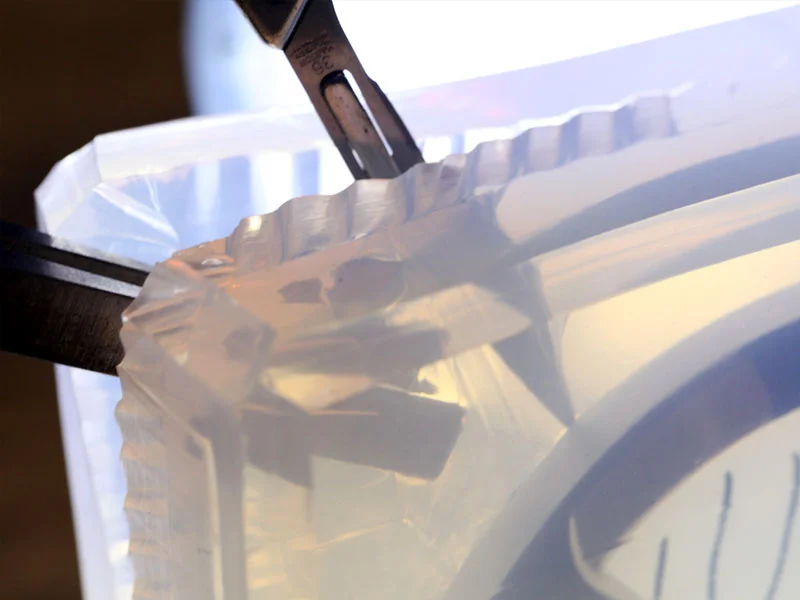 Cutting a Transparent Silicone Mold
1.2 Easier Inspection of Material Flow and Cavity Filling During Casting
During resin casting and prototype replication, transparent silicone provides a certain degree of visibility into the mold interior.
Depending on the mold structure, wall thickness, and transparency of the casting material, operators may be able to observe certain visible areas and check:
- Whether the casting material has reached the intended areas.
- Whether there are any obvious unfilled areas in the visible mold cavities.
- Whether inserts or other internal components have shifted out of position.
- Whether any noticeable air bubbles can be seen from outside the mold.
This visibility is particularly useful for vacuum casting of complex parts, jewelry resin casting, and precision prototype production.
However, transparent silicone does not guarantee that all internal defects can be observed. Areas hidden by the master pattern, tiny air bubbles, and voids outside the viewing area may still require inspection after demolding and other quality control methods.
1.3 Retaining Silicone Rubber Flexibility and Detail Reproduction
Transparency is an optical property of the material, while flexibility, tear strength, and detail reproduction are mechanical and processing properties of silicone rubber.
High-quality transparent mold-making silicone combines good visibility with the ability to reproduce fine surface textures on the master pattern. Its flexibility also helps operators remove castings with complex shapes from the mold.
Hardness and tear strength are two important properties to consider when selecting mold-making silicone:
- Hardness (Shore A): Determines how soft or firm the cured mold is and how well it resists deformation. Lower-hardness silicone is generally easier to flex and is suitable for applications that require greater deformation during demolding.
- Tear Strength: Affects the mold's ability to resist tearing around cuts, thin sections, and during repeated demolding.
Therefore, when selecting transparent silicone, do not focus solely on its clarity. Choose the appropriate hardness and mechanical properties based on the master pattern structure and demolding method.
1.4 Low Shrinkage Helps Maintain Mold Dimensional Stability
For precision prototypes, jewelry models, and industrial parts requiring dimensional consistency, curing shrinkage is an important material property.
Addition-cure silicone (platinum-catalyzed silicone) generally offers low curing shrinkage, helping minimize dimensional changes during master pattern replication.
For example, the technical specifications for MinghuiLink's transparent liquid silicone series state a linear shrinkage rate of no more than 0.1%.
It is important to understand that low shrinkage comes from the specific material formulation and curing system, not from transparency itself. Actual dimensional stability is also affected by curing temperature, curing conditions, and mold structure.
2. Typical Applications of Transparent Mold-Making Silicone
Transparent silicone is not necessary for every mold-making project. It is best suited to applications where visibility of the master pattern, internal structure, or casting process is important.
2.1 Jewelry Molds and Lost-Wax Casting
Jewelry, rings, and intricate accessories often feature complex curved surfaces and fine details. Using transparent silicone to make cut block molds allows operators to see the position of the master pattern and plan the cutting path more accurately.
For lost-wax casting processes that require repeated production of wax patterns, transparent molds also make it easier to inspect internal structures.
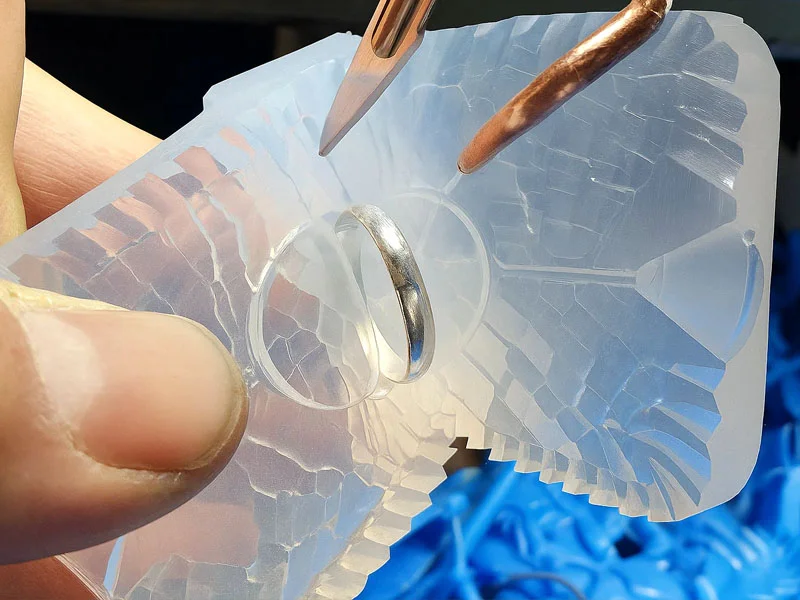 Transparent Silicone Jewelry Mold
2.2 Rapid Prototyping and Vacuum Casting
In product development and small-batch prototype production, silicone molds are often used with polyurethane (PU) casting resins formulated for the required performance. This process can reproduce parts with an appearance or certain performance characteristics similar to engineering plastics such as ABS and PC.
Transparent silicone helps operators observe how the casting material flows and fills the mold cavity, providing useful information for adjusting the process when producing complex parts.
This makes it suitable for rapid replication of consumer electronics housings, automotive component prototypes, and other precision models.
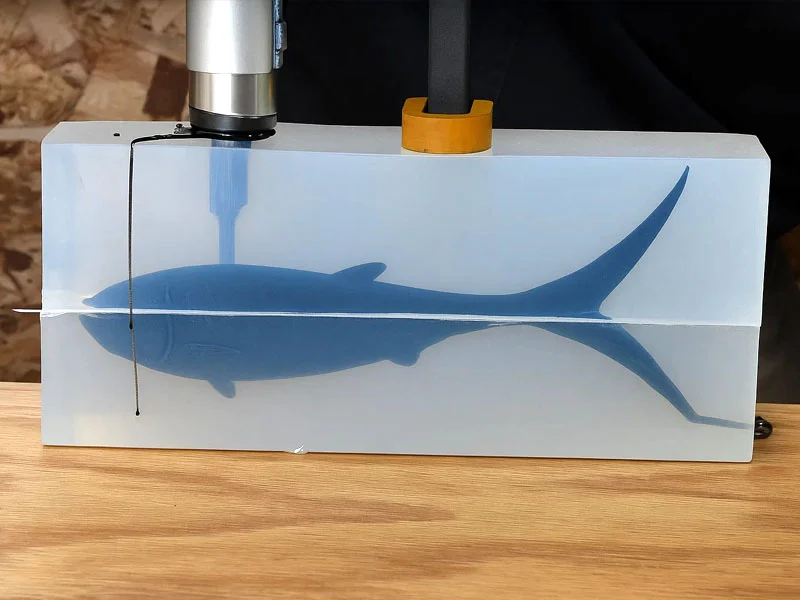 Vacuum Casting with a Transparent Silicone Mold
2.3 Epoxy Resin and Other Resin Applications
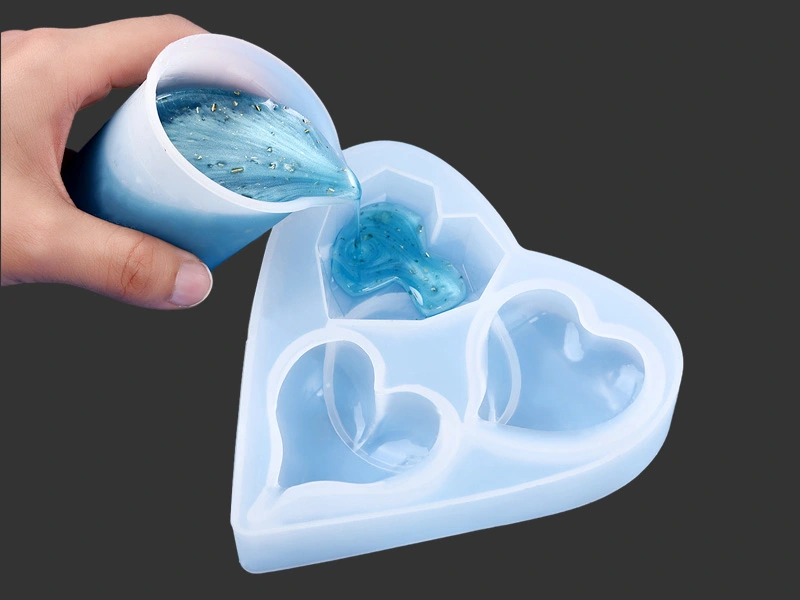
Transparent silicone molds can also be used for casting materials such as epoxy resin, polyurethane resin, polyester resin, and wax.
When making clear resin jewelry, decorative models, or parts with complex shapes, transparent molds allow operators to observe some casting areas and use appropriate processing techniques to help reduce filling defects.
Whether a material can be cast directly should still be verified through compatibility testing based on the specific silicone grade, resin formulation, and release agent requirements.
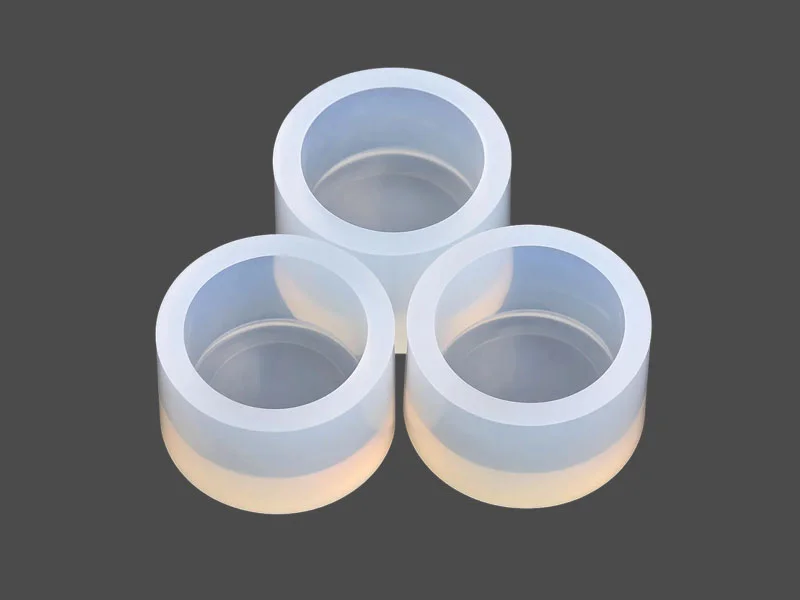 Transparent Silicone Mold for Epoxy Resin
3. Differences Between Transparent and Translucent Silicone
Product descriptions for silicone materials often use terms such as Clear, Transparent, and Translucent.
In general:
- Clear / Transparent: Usually indicates relatively high optical clarity, allowing objects and their outlines inside the material to be seen more clearly.
- Translucent: Allows light to pass through but scatters some of it, so objects inside the material may appear blurred or have less distinct outlines.
However, product naming and description standards vary between manufacturers. Some products may use both Water Clear and Translucent to describe their appearance. Therefore, the actual transparency should not be judged by the product name alone.
When selecting a product, consider the following factors:
- Actual transparency after curing, rather than the appearance of the uncured Parts A and B.
- Visibility through different mold wall thicknesses.
- Whether the material contains air bubbles, impurities, or noticeable optical defects.
- Whether the outline of the master pattern can be clearly identified under the actual lighting and viewing conditions.
For molds that require precise cutting, it is recommended to request a cured sample or prepare a small test piece with a thickness close to that of the actual mold.
Transparency should be evaluated based on actual application performance rather than simply aiming for a glass-like appearance.
4. How to Choose the Right Transparent Liquid Silicone
When selecting transparent liquid silicone, consider the master pattern structure, required mold hardness, casting material, and processing conditions together.
4.1 Choose Hardness Based on Mold Structure
Hardness directly affects the flexibility and support capacity of the mold.
In general:
- 10–20 Shore A: Offers good flexibility and is suitable for demolding applications that require greater deformation, particularly with complex undercut structures.
- 30–40 Shore A: Generally provides better support and shape retention, making it suitable for prototype production and precision casting applications that require greater mold rigidity.
Lower-hardness materials are not necessarily suitable for every complex mold. Their tear strength must still be sufficient for the application. Although higher-hardness materials generally retain their shape more effectively, they may make demolding more difficult when deep undercuts or complex structures are involved.
4.2 Choose the Material Based on Tear Strength
Tear strength is particularly important for molds that will be reused frequently or have narrow cuts.
It is recommended to compare the following properties:
- Tear Strength.
- Tensile Strength.
- Elongation at Break.
These properties should be evaluated together with hardness. Mold durability cannot be determined by relying on a single performance indicator.
4.3 Choose the Material Based on Viscosity and Processing Equipment
The viscosity of transparent liquid silicone varies depending on the formulation and product grade. It affects material flow, pouring, and degassing efficiency in complex mold cavities. For master patterns with fine details, deep grooves, or narrow sections, evaluate flowability and degassing requirements based on the product's viscosity. For high-viscosity grades, suitable vacuum degassing equipment is recommended. Always follow the product instructions for mixing, degassing, and pouring.
4.4 Confirm the Mixing Ratio and Working Time
RTV-2 transparent liquid silicone consists of two components, Parts A and B. Different grades may use different mixing ratios, such as 1:1 or 10:1.
When selecting a product, confirm the following:
- Whether the mixing ratio is specified by weight or by volume.
- Whether the working time (Pot Life) is sufficient for measuring, mixing, degassing, and pouring.
- Whether the curing time (Cure Time) meets the production schedule.
- Whether moderate heating is permitted to accelerate curing.
For the MinghuiLink transparent silicone series, Parts A and B must be weighed according to the mixing ratio specified in the TDS for the corresponding grade. Parts A and B from different grades must not be mixed interchangeably.
4.5 Confirm Shrinkage and Temperature Resistance
If the mold is used for precision part replication or high-temperature casting, also check the following properties:
- Linear Shrinkage.
- Operating Temperature.
- Heat Resistance.
- Thermal compatibility with the specific casting material.
In particular, when using resins that generate heat during curing, consider the amount of heat released and how long the mold is exposed to it. Suitability should not be determined solely by the silicone's stated temperature resistance.
5. Precautions and Material Compatibility
The actual performance of transparent silicone depends not only on the material itself but also on the master pattern surface, mixing process, and curing environment.
5.1 Be Aware of Cure Inhibition in Platinum-Cure Silicone
Addition-cure (platinum-catalyzed) silicone is sensitive to certain chemicals. Contact with incompatible materials may cause cure inhibition, resulting in tacky contact surfaces, incomplete curing, or localized uncured areas.
Common potential sources of inhibition include:
- Sulfur-based modeling clay.
- Condensation-cure (tin-catalyzed) silicone and its residues.
- Latex gloves and certain natural rubber materials.
- Certain amine-based curing agents, incompletely cured epoxy resin, and its residues.
- Certain 3D printing resins that have not been adequately cleaned or cured.
- Some paints, coatings, and other chemical contaminants.
Before making a production mold, it is recommended to conduct a small-scale curing test to confirm that the master pattern surface, sealers, release agents, and other contact materials will not interfere with silicone curing.
5.2 Mix Thoroughly and Use Vacuum Degassing Correctly
To improve the quality of the finished transparent mold, pay particular attention to the following steps:
- Accurately weigh Parts A and B according to the mixing ratio specified for the product.
- Mix thoroughly to avoid unevenly mixed areas.
- Perform vacuum degassing according to the material viscosity and processing requirements.
- Pour slowly to minimize the introduction of additional air.
- Allow the material to cure under the recommended temperature and time conditions.
Air bubbles inside a transparent mold affect visibility. Therefore, proper degassing is essential for producing a clear and uniform transparent mold.
5.3 Determine Mold Release Requirements Based on the Casting Material
Silicone rubber generally has good release properties, but whether an additional release agent is needed depends on the casting material, mold formulation, and production frequency.
For example, epoxy resin, polyurethane resin, and polyester resin may have different release requirements. Test the specific combination of silicone and casting material. When necessary, use a suitable release agent to reduce sticking and extend the service life of the mold.
In addition, if the transparent mold is intended for food-contact applications, select a specific silicone grade with the relevant food-contact compliance documentation. Transparency, low odor, or platinum catalysis alone does not mean that a product has received food-contact certification.
6. Temperature Resistance of Transparent Liquid Silicone
When researching transparent liquid silicone, users sometimes search for terms such as Silicone Melting Point.
In fact, cured silicone rubber is a crosslinked elastomer, unlike thermoplastic materials that can be melted again by heating. Once fully cured, silicone cannot be returned to its original liquid Parts A and B simply by applying heat.
When the temperature exceeds the material's allowable range, silicone rubber may gradually undergo changes in performance and thermal degradation rather than melting into a liquid that can be poured again, as plastics or waxes may do.
Therefore, when selecting mold-making silicone, focus on the product's temperature resistance range rather than looking for a specific silicone melting point.
For high-temperature casting projects, also consider the peak exothermic temperature of the resin during curing, the duration of contact, and the effect of repeated thermal cycles on mold service life.
The technical documentation for the MinghuiLink transparent liquid silicone series specifies heat resistance of 250°C. Please note that this value should not be interpreted as the continuous long-term operating temperature. Actual use conditions should be determined according to the TDS for the specific grade and practical test results.
7. Frequently Asked Questions (FAQ)
- Q1: Are transparent silicone molds better than conventional silicone molds?
- Not necessarily. The main advantage of transparent silicone is visibility. It is suitable for projects that require viewing the master pattern, planning cutting paths, or inspecting the casting process. If these features are not needed, conventional opaque silicone may be a more economical and appropriate choice. The final selection should be based on hardness, tear strength, shrinkage, and project requirements.
- Q2: Can transparent liquid silicone improve mold detail reproduction?
- Transparency itself does not improve detail reproduction. The ability of a mold to reproduce fine surface textures mainly depends on the silicone's viscosity, flowability, master pattern surface quality, and processing conditions. Transparency primarily helps operators observe the internal structure.
- Q3: Can transparent silicone be used for epoxy resin and polyurethane resin casting?
- Many transparent mold-making silicone products can be used for epoxy resin and polyurethane resin casting. However, compatibility testing should be carried out based on the specific silicone formulation, resin system, and mold release requirements.
- Q4: Can transparent silicone completely prevent air bubbles during casting?
- No. Transparency helps operators observe some visible air bubbles, but it does not eliminate them. Air bubbles should be controlled through accurate mixing, vacuum degassing, proper pouring techniques, and optimization of the master pattern structure.
- Q5: Is transparent silicone suitable for making molds with complex structures?
- Yes, but the hardness and tear strength must be selected according to the mold structure. For master patterns with deep undercuts and complex curved surfaces, pay particular attention to flexibility and the demolding method. For molds requiring greater dimensional stability, a higher-hardness transparent silicone may be considered.
8. Conclusion
The real value of transparent mold-making silicone lies in combining the mold-making performance of silicone rubber with internal visibility. Whether the application involves jewelry mold making, resin casting, or precision prototyping, the appropriate formulation should be selected based on the master pattern structure, casting material, mold hardness, and production process.

We value your comments, but please refrain from posting meaningless or irrelevant content. Kindly review our Comment Policy before commenting.