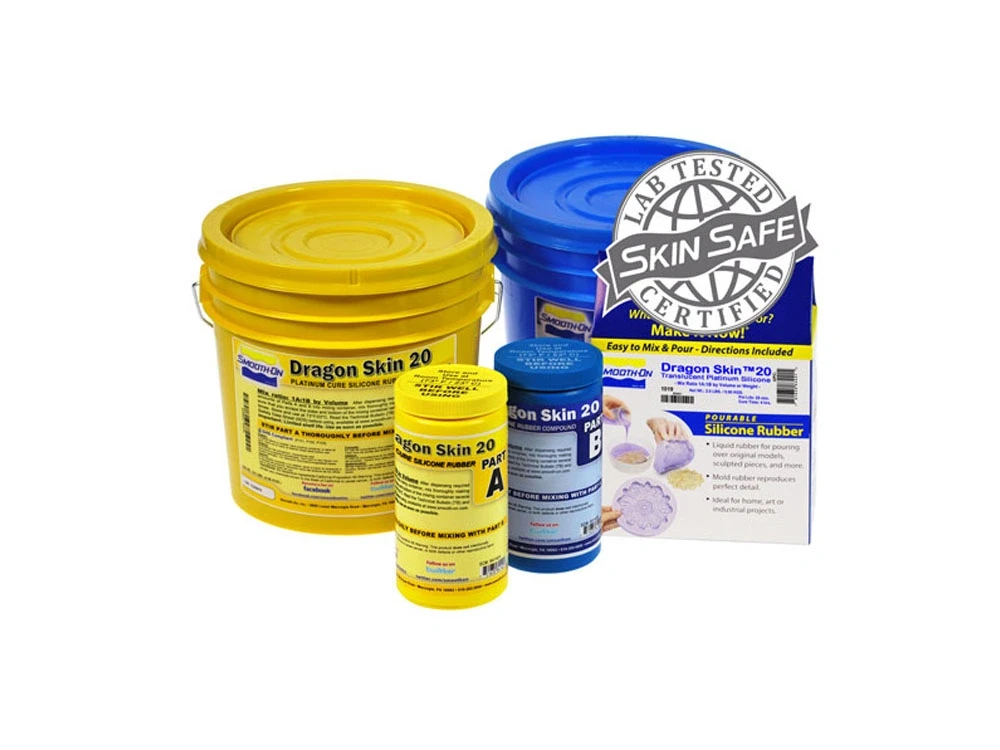
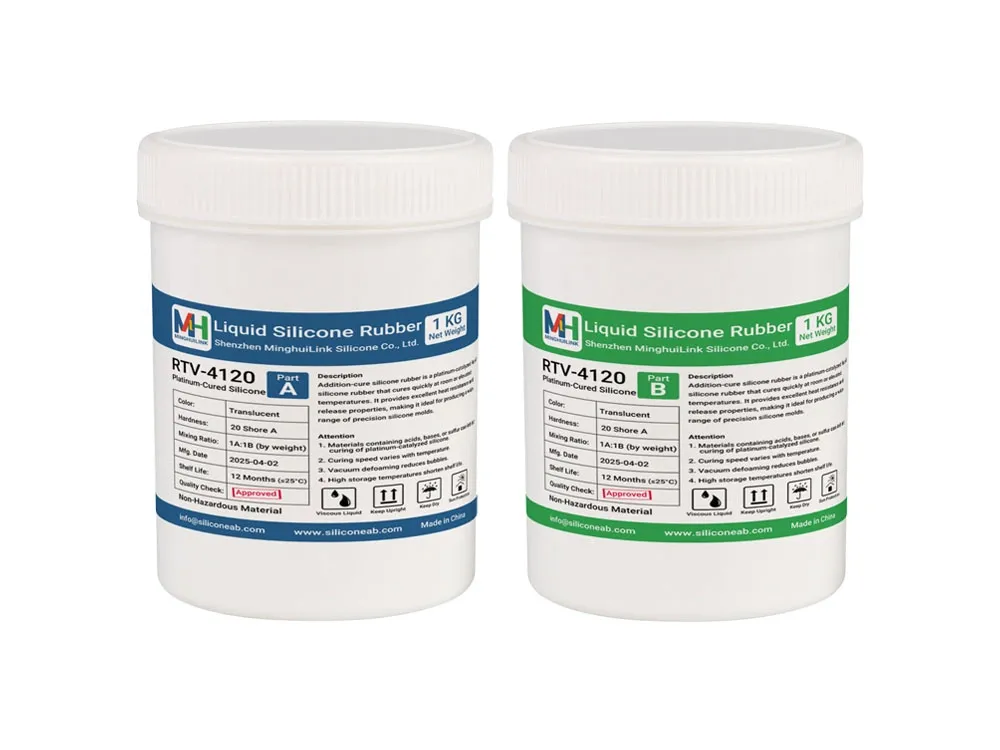
Dragon Skin™ 20 and RTV-4120 share the same Shore A20 hardness and 1:1 mix ratio, so the main selection differences are not in nominal hardness but in processing characteristics and published mechanical properties. Both provide a balance of flexibility and mold support, making them suitable for many reusable mold-making and casting applications.
The mechanical data show different performance profiles. Smooth-On reports 620% elongation, 550 psi tensile strength and 120 pli tear strength for Dragon Skin™ 20, while RTV-4120 reports 550% elongation, 5.0 MPa tensile strength and 27.0 N/mm tear strength. Dragon Skin™ 20 therefore has higher published elongation, while RTV-4120 reports higher published tensile and tear strength. These figures should be treated as manufacturer-published data rather than a direct laboratory ranking because testing methods and conditions may differ.
Processing time is another practical difference. Dragon Skin™ 20 has a published 25-minute pot life and 4-hour cure time, while RTV-4120 has a 35-minute working time and 5-hour cure time. The longer working window of RTV-4120 may be useful for larger molds or processes that require additional time for mixing, degassing and pouring, whereas Dragon Skin™ 20 offers the shorter published cure cycle.
Viscosity is one of the largest published differences between the two materials. Smooth-On lists Dragon Skin™ 20 at 20,000 cps as a mixed material, while MinghuiLink lists approximately 4,700 mPa·s for Part A of RTV-4120. Because the reported values are measured at different points in the mixing process, they should not be treated as a strict like-for-like viscosity comparison. In practical mold making, the intended mold geometry, detail level, air-release requirements and pouring method should be considered when evaluating flow behavior.
For users choosing between these materials, RTV-4120 may be worth evaluating when longer working time and higher published tensile and tear strength are priorities, while Dragon Skin™ 20 may be preferable when higher published elongation and a shorter cure cycle are more important. Final selection should also consider mold thickness, undercuts, expected casting cycles, demolding method and compatibility with the master pattern and casting material.