CENUSIL® M 825 A/B vs RTV-4125 Silicone Comparison

CENUSIL® M 825 A/B and MinghuiLink RTV-4125 are both Shore A25 addition-cure silicone systems for reusable molds. They have similar hardness, but differ mainly in working time, viscosity, mechanical properties and application positioning. M 825 A/B is specifically positioned for extensive undercuts, accurate reproduction and concrete molding, while RTV-4125 offers lower published component viscosity and a clearly specified numerical tear-strength value.

WACKER

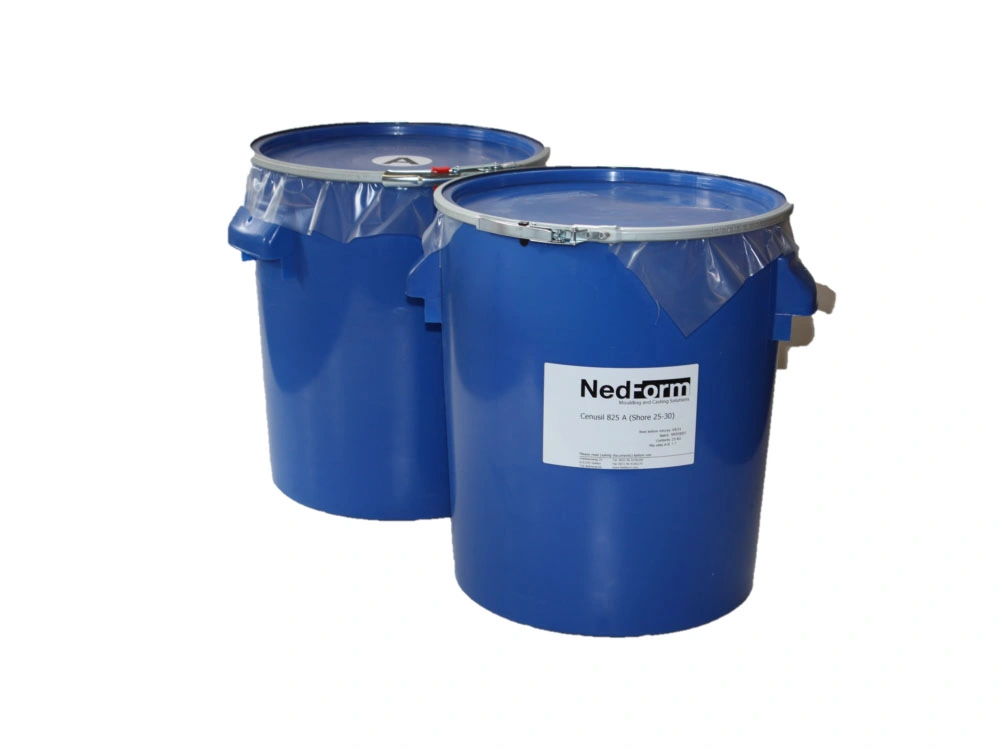
CENUSIL® M 825 A/B

Addition-Cure Silicone

  • Hardness
    25 Shore A
  • Mix Ratio
    1:1
  • Working Time
    60 min

Visit Product

VS
MinghuiLink

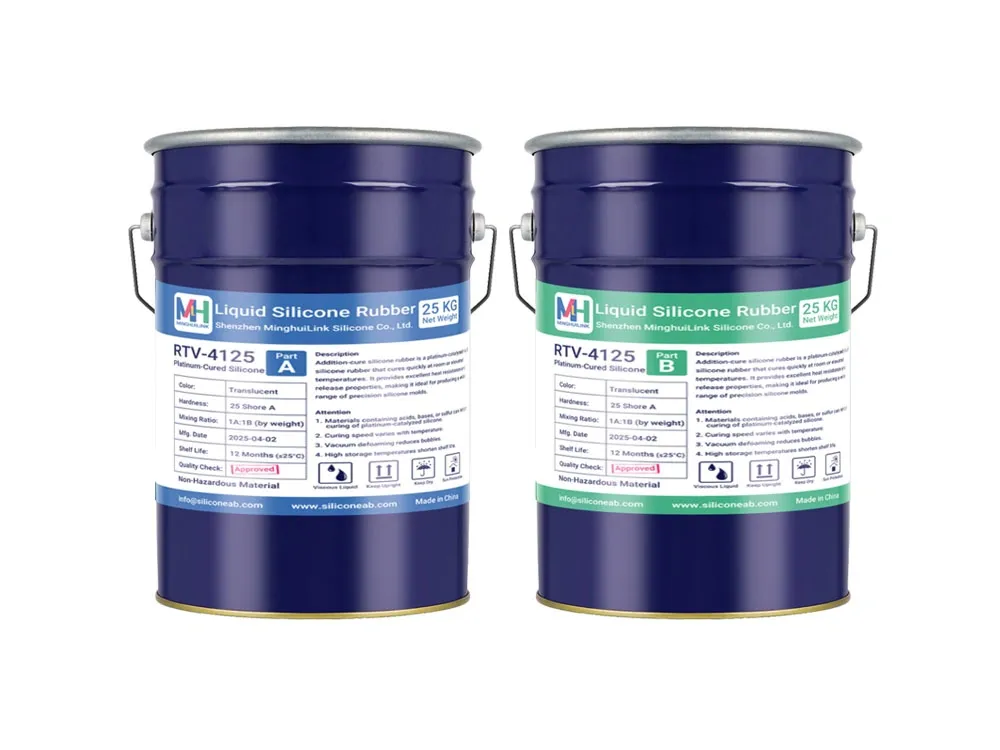
RTV-4125

Platinum-Cure Silicone

  • Hardness
    25±1 Shore A
  • Mix Ratio
    1:1
  • Working Time
    35 min

Visit Product

Conclusion

CENUSIL® M 825 A/B and RTV-4125 are both Shore A25 mold silicones, but they are suited to different priorities. M 825 A/B is the stronger fit for extensive undercuts, accurate reproduction, concrete molding and longer processing time. RTV-4125 is better aligned with users who prioritize lower published component viscosity, a clearly specified tear strength and straightforward general-purpose mold production.


  • Longer Working Time:
    M 825 A/B provides a published 60-minute working time versus 35 minutes for RTV-4125, giving more processing time for larger or more detailed molds.

  • Extensive Undercuts:
    WACKER specifically positions M 825 A/B for models with extensive undercuts and accurate reproduction, making it a strong candidate for complex mold geometry.

  • General Production:
    RTV-4125 publishes lower component viscosities and a numerical 26±0.5 N/mm tear-strength value, supporting routine handling and evaluation of thin mold sections.

1. Technical Assessment

CENUSIL® M 825 A/B and RTV-4125 are both Shore A25-class addition-cure silicone systems for reusable mold making, so hardness is not a major selection factor. The main differences are processing time, viscosity, mechanical properties and application positioning. WACKER specifically positions M 825 A/B for accurate reproduction, extensive undercuts and concrete molding, while RTV-4125 is positioned as a general-purpose A25 mold silicone.

The clearest processing difference is working time. M 825 A/B provides approximately 60 minutes versus 35 minutes for RTV-4125, giving more time for large or detailed mold preparation, deaeration and controlled pouring. RTV-4125 publishes lower component viscosities—approximately 4,700±200 mPa·s for Part A and 4,400 mPa·s for Part B, compared with approximately 8,000 mPa·s for both M 825 A/B components. However, WACKER also describes M 825 A/B as having excellent flowability and self-deaeration, so viscosity alone does not determine handling performance. Both use a simple 1:1 mixing system.

The mechanical comparison is relatively balanced. M 825 A/B publishes 5.0 MPa tensile strength and 450% elongation, while RTV-4125 publishes 4.0±0.5 MPa tensile strength and 460±50% elongation. The published tensile value therefore favors M 825 A/B, while elongation is very similar. RTV-4125 publishes a numerical tear strength of 26±0.5 N/mm, whereas WACKER describes M 825 A/B as having high tear strength without providing a directly comparable numerical value in the referenced documentation.

M 825 A/B has the stronger application-specific positioning for complex molding. WACKER specifically identifies extensive undercuts, accurate reproduction, concrete casting and reproduction molding, making it particularly relevant when mold geometry and dimensional fidelity are the main concerns. RTV-4125 is better suited to users seeking straightforward general-purpose A25 mold production, especially where lower published component viscosity and a defined tear-strength specification are useful.

Both materials can be considered for resin and detailed mold applications, but very soft A25 molds may require additional structural support when used with large or heavy castings. Addition-cure compatibility should also be checked with unfamiliar masters, coatings and 3D-printed materials before production. Overall, M 825 A/B is differentiated by its longer working time, excellent flowability, self-deaeration and specific positioning for extensive undercuts and concrete/reproduction molds, while RTV-4125 emphasizes lower published component viscosity and a stronger documented numerical tear-strength profile.
2. Technical Comparison

Technical Parameter WACKER CENUSIL® M 825 A/B MinghuiLink RTV-4125
Silicone Type Addition-cure RTV-2 Platinum-cure silicone
Color Not publicly listed Translucent
Specific Gravity 1.05 g/cm³ 1.06–1.08 g/cm³
Mix Ratio 1A:1B 1A:1B by weight or volume
Shore Hardness 25 Shore A 25±1 Shore A
Viscosity 8,000 mPa·s (Part A) 4,700±200 mPa·s* (Part A)
Working / Pot Life 60 min 35 min
Demold / Cure Time 6 h demoldable 5 h cure
Tensile Strength 5.0 MPa 4.0±0.5 MPa
Tear Strength High tear strength; numerical value not publicly listed 26±0.5 N/mm
Elongation 450% 460±50%
Shrinkage No chemical shrinkage ≤0.1%
Temperature Resistance Not publicly listed Up to 250°C / 482°F
Flow / Deaeration Excellent flowability; good self-deaeration Low published component viscosity; vacuum degassing recommended when required
Typical Applications Concrete casting molds, reproduction molding, automotive molding and models with extensive undercuts Reusable molds, resin casting and general A25 mold-making applications
Technical Data Sources CENUSIL® M 825 A/B RTV-4125

3. Key Differences

Key Factor WACKER CENUSIL® M 825 A/B MinghuiLink RTV-4125 What It Means
Hardness 25 Shore A 25±1 Shore A Both target essentially the same A25 mold range.
Mixing System 1:1 1:1 Both use a simple equal-parts mixing system.
Working Window 60 min 35 min M 825 A/B provides substantially more processing time for detailed or large mold preparation.
Component Viscosity 8,000 / 8,000 mPa·s 4,700 / 4,400 mPa·s RTV-4125 publishes lower component viscosities, while M 825 A/B is specifically described as having excellent flowability.
Tensile Strength 5.0 MPa 4.0±0.5 MPa M 825 A/B publishes the higher tensile-strength value.
Tear Strength High tear strength; numerical value not publicly listed 26±0.5 N/mm RTV-4125 provides a numerical specification; WACKER describes M 825 A/B qualitatively as high tear strength.
Elongation 450% 460±50% The published elongation values are very close and overlap substantially.
Dimensional Shrinkage No chemical shrinkage ≤0.1% M 825 A/B places stronger emphasis on dimensional reproduction and non-shrink curing.
Undercut Positioning Extensive undercuts Flexible undercuts M 825 A/B has a more specific manufacturer positioning for models with extensive undercuts.
Application Focus Concrete, reproduction and automotive molding General A25 mold making and casting M 825 A/B has a more explicit industrial reproduction and concrete-mold orientation.
Heat Resistance Not publicly listed 250°C / 482°F RTV-4125 provides the clearer numerical heat-resistance specification.

4. Application Comparison

Application CENUSIL® M 825 A/B RTV-4125 Key Consideration
Extensive Undercuts Strong candidate Strong candidate Both are A25 materials, while WACKER specifically positions M 825 A/B for models with extensive undercuts.
Detailed Reproduction Strong candidate Strong candidate M 825 A/B combines excellent flowability, self-deaeration and no chemical shrinkage with explicit accurate-reproduction positioning.
Concrete Casting Molds Strong candidate Suitable with testing WACKER specifically identifies concrete casting molds as a main application for M 825 A/B.
Automotive / Reproduction Molds Strong candidate Suitable WACKER specifically lists automotive and reproduction molding among M 825 A/B applications.
Large / Complex Molds Strong candidate Suitable The 60-minute working window gives M 825 A/B more processing time for extended mold preparation and controlled pouring.
Thin Mold Edges Suitable with testing Strong candidate RTV-4125 provides a published 26±0.5 N/mm tear-strength value for durability evaluation around thin or repeatedly handled edges.
General Resin Casting Strong candidate Strong candidate Both can be evaluated for reusable resin molds; compatibility depends on the specific casting chemistry.
Rapid Mold Production Strong candidate Strong candidate WACKER reports approximately 6 hours to a demoldable state, while MinghuiLink reports approximately 5 hours cure; the published endpoints are not identical.
High-Temperature Applications Suitable with temperature validation Strong candidate RTV-4125 provides a published 250°C heat-resistance specification, while M 825 A/B requires application-specific validation.

5. FAQ

Compare Another Silicone

Need Help Choosing?

Tell us your application. We’ll recommend the right RTV-2 silicone and provide a sample for testing.

Request a Sample