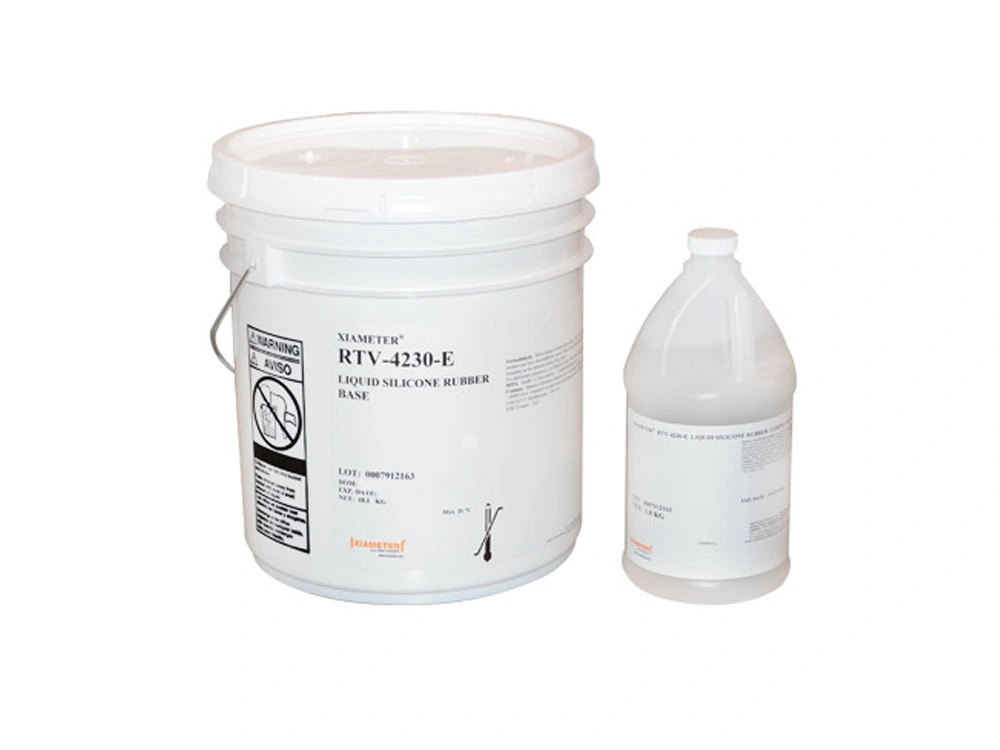
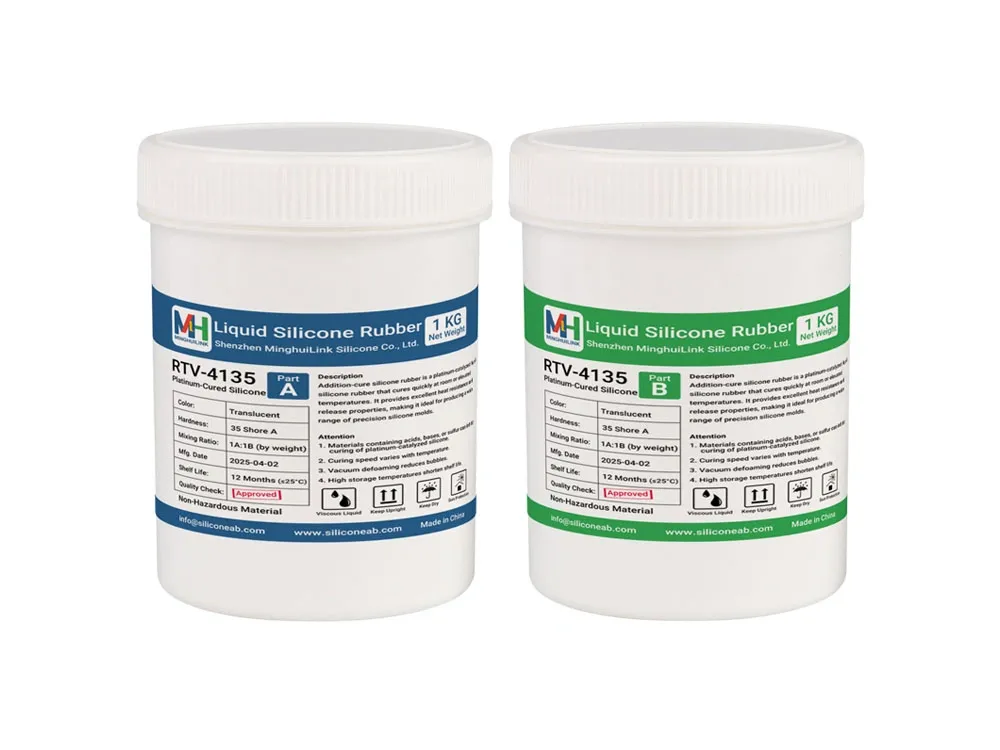
SILASTIC™ RTV-4230-E and RTV-4135 are both addition-cure silicone systems for reusable mold making in the Shore A35 range. Dow's current product page lists 37 Shore A for RTV-4230-E, while MinghuiLink lists 35±1 Shore A for RTV-4135. Dow technical documentation has also reported 35 Shore A, so the small hardness difference should not be treated as a major selection factor.
The main distinction is application positioning. Dow specifically positions RTV-4230-E for unusual configurations, severe undercuts and close-tolerance molds, highlighting easy release, high strength, high elongation and low shrinkage. RTV-4135 is positioned more generally for reusable molds and emphasizes simpler processing, higher published tear strength and faster curing.
Working time is one of the clearest process differences. RTV-4230-E provides approximately 90 minutes, compared with 35 minutes for RTV-4135. The longer window gives operators more time for large or complicated mold preparation, vacuum deaeration and controlled pouring.
Mixing is simpler with RTV-4135. It uses a 1:1 ratio, compared with 10:1 by weight for RTV-4230-E. For frequent manual batching or small production runs, the equal-parts system reduces measuring complexity.
Viscosity also differs substantially. Dow lists approximately 55,000 cP for mixed RTV-4230-E, while MinghuiLink publishes approximately 4,500±200 mPa·s for RTV-4135 Part A and 4,000±200 mPa·s for Part B. Because the manufacturers report different material states, these values are not a strict like-for-like viscosity comparison. They nevertheless indicate different handling characteristics, with RTV-4135 reporting lower component viscosities.
The mechanical data show a trade-off. RTV-4230-E publishes approximately 5.5 MPa tensile strength, 19 N/mm tear strength and 350% elongation. RTV-4135 publishes 4.8±0.5 MPa tensile strength, 28±0.5 N/mm tear strength and 300±50% elongation. RTV-4230-E therefore has the higher published tensile strength and elongation, while RTV-4135 has the higher numerical tear-strength value.
These properties address different failure modes. Higher elongation can be useful when a mold must stretch around severe undercuts, while tear strength is more relevant to resistance against cuts and crack propagation. RTV-4230-E therefore has a stronger published profile for difficult demolding, while RTV-4135 offers an advantage in published tear strength.
Cure time favors RTV-4135 for faster routine production. Dow publishes approximately 24 hours for RTV-4230-E under the stated room-temperature condition, compared with approximately 5 hours for RTV-4135. Dow also notes that RTV-4230-E can be heat-accelerated, providing an additional option for production environments with controlled heating.
RTV-4230-E also has specific positioning for polyester, plaster, rigid and foam polyurethane, and epoxy applications, while RTV-4135 is positioned more generally for mold making and casting. Compatibility should still be verified with the actual casting material and production conditions.
Both materials can be used for detailed and reusable molds, but the better choice depends on the production constraint. RTV-4230-E is more suitable when the mold has difficult geometry, severe undercuts or requires a long working window. RTV-4135 is better aligned with routine production where simple 1:1 mixing, lower published component viscosity, higher published tear strength and faster curing are more important.