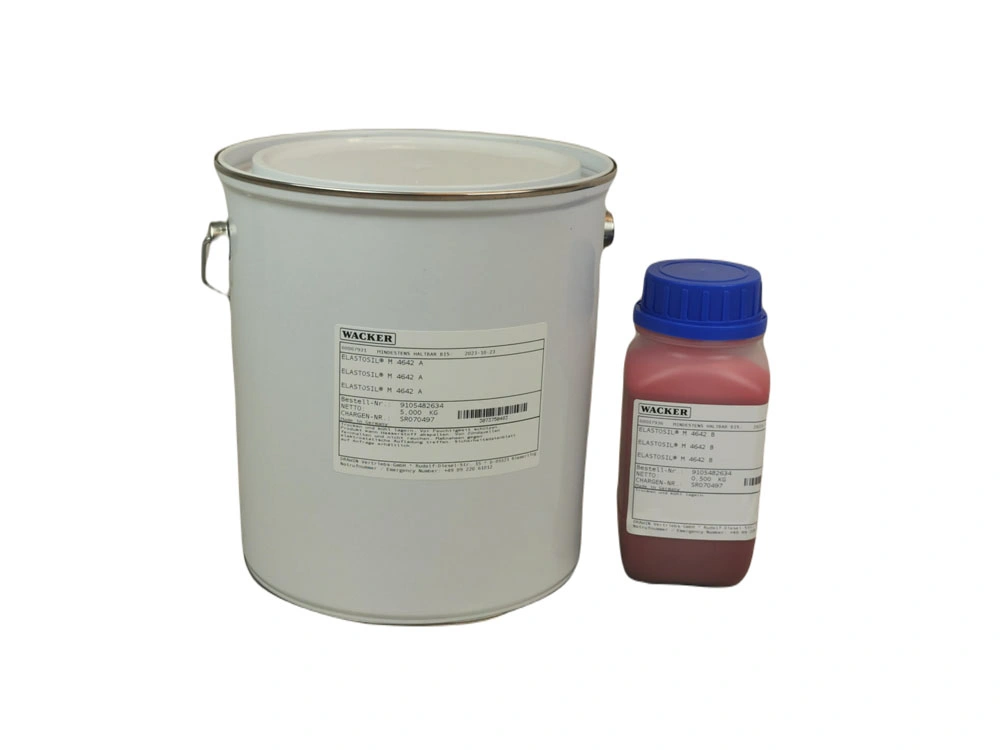
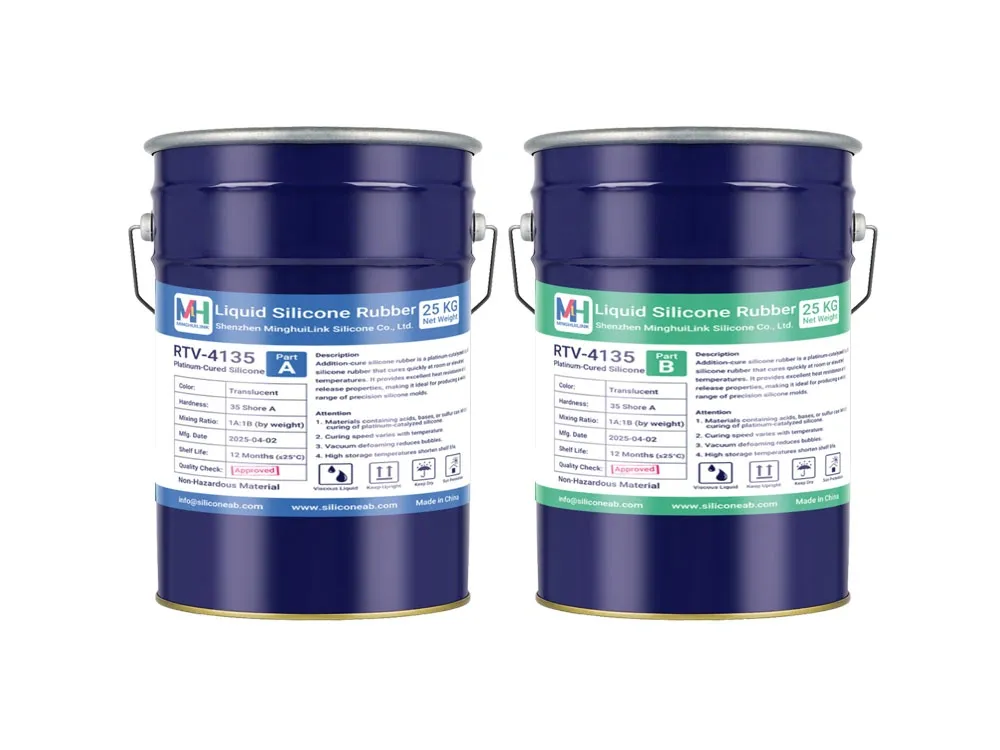
ELASTOSIL® M 4642 A/B and RTV-4135 are close in hardness, with M 4642 at 37 Shore A and RTV-4135 at 35±1 Shore A. M 4642 is slightly firmer, while both remain suitable for medium-hard reusable molds.
The biggest processing difference is the mixing system and working window. M 4642 uses a 10:1 ratio with approximately 90 minutes of pot life, while RTV-4135 uses a simpler 1:1 ratio and approximately 35 minutes of working time. M 4642 therefore provides substantially more time for large or complex mold preparation, while RTV-4135 is easier to proportion for small manual batches.
Viscosity also favors RTV-4135 for routine handling. M 4642 publishes approximately 20,000 mPa·s for Part A and 700 mPa·s for Part B, with approximately 15,000 mPa·s mixed viscosity. RTV-4135 publishes approximately 4,500 mPa·s for Part A and 4,000 mPa·s for Part B. The component values should be considered together with the different mix ratios, but RTV-4135 has the lower published component viscosities.
M 4642 has the stronger published mechanical profile. It reports 7.0 MPa tensile strength, >30 N/mm tear strength and 480% elongation, compared with 4.8±0.5 MPa, 28 N/mm and 300±50% for RTV-4135. The higher tensile and tear values provide greater published mechanical margin, while the higher elongation supports more demanding flexible demolding.
WACKER specifically positions M 4642 for reproduction molds with undercuts and resistance to common casting resins. This makes it particularly relevant to demanding reusable molds where both dimensional reproduction and mechanical durability matter. RTV-4135 is better characterized as a general-purpose A35-class platinum-cure silicone for routine mold making and casting.
Published turnaround favors RTV-4135, although the reported endpoints differ. WACKER lists approximately 12 hours to a tack-free state for M 4642, while MinghuiLink lists approximately 5 hours cure time for RTV-4135. These values are not directly equivalent test endpoints, but RTV-4135 is better aligned with shorter published routine production cycles.
Both materials are low-shrinkage addition-cure silicones. M 4642 publishes less than 0.1% linear shrinkage, while RTV-4135 publishes no more than 0.1%. For large molds, mold-wall thickness, support structure and casting weight still need to be considered regardless of the selected silicone.
Overall, M 4642 is differentiated by higher published mechanical performance, a much longer working window and explicit positioning for demanding reproduction and undercut molds. RTV-4135 is differentiated by 1:1 processing, lower published component viscosity and shorter published cure time.