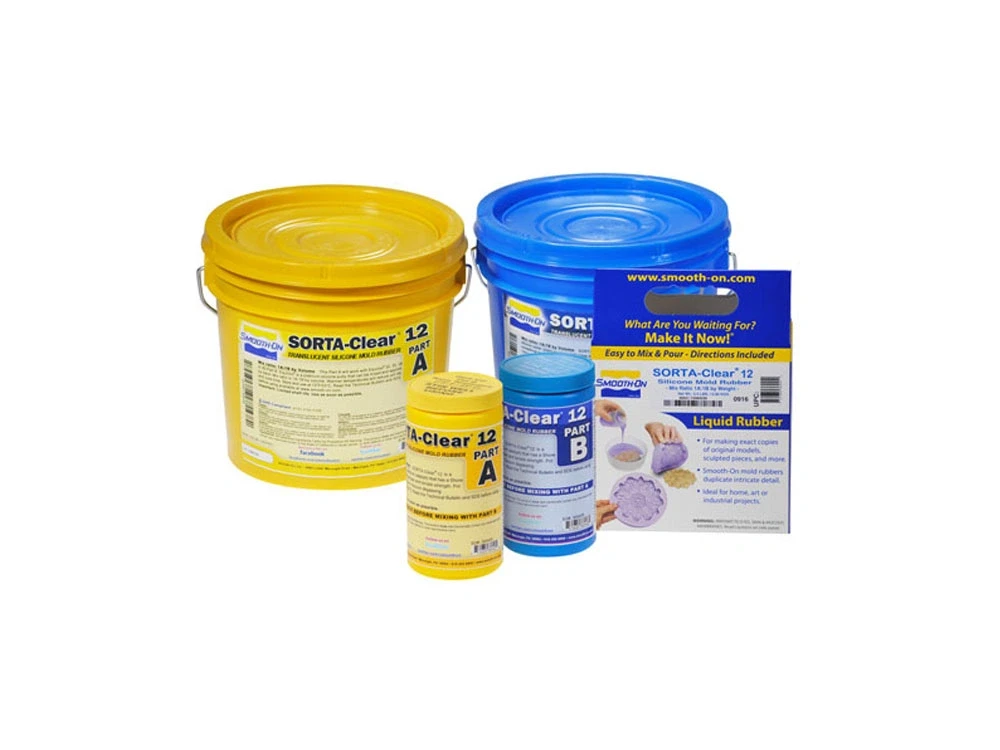
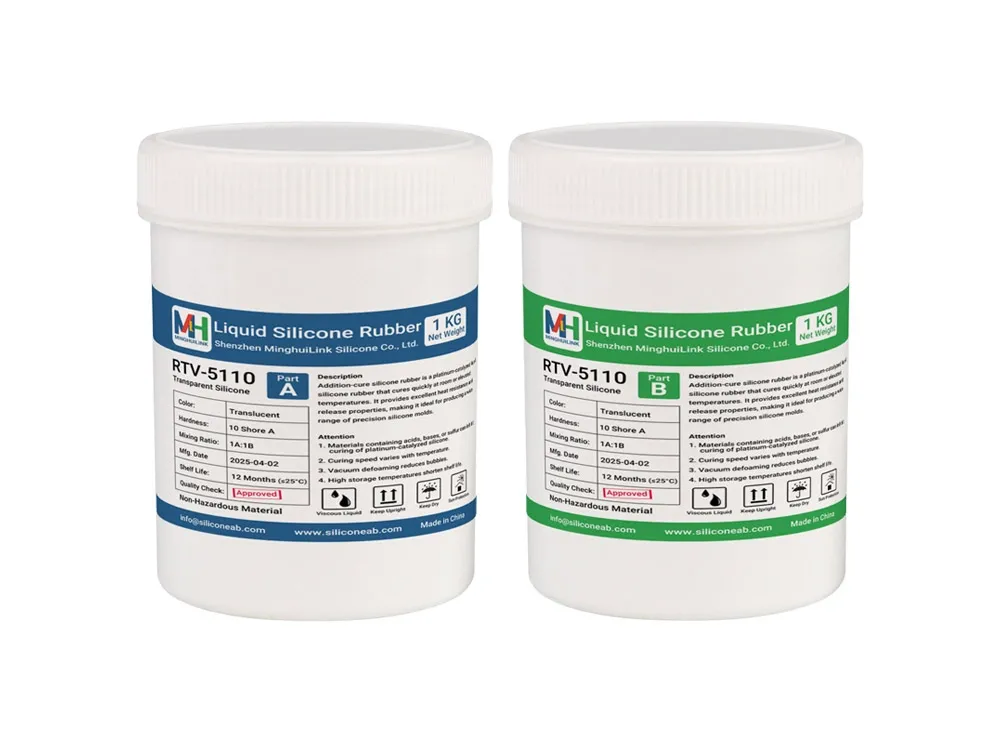
SORTA-Clear™ 12 and RTV-5110 are both transparent platinum-cure silicones intended for applications where mold flexibility and internal visibility are useful. SORTA-Clear™ 12 is specified at 12 Shore A, while RTV-5110 is listed at 10±2 Shore A. The difference is relatively small, but the softer RTV-5110 profile may favor applications where the cured mold needs to deform more readily during demolding.
The main distinction between the two materials is not simply softness, but what users need from a transparent mold. Smooth-On specifically positions SORTA-Clear™ 12 for prototype, jewelry and other molds where model visibility is important, including applications where the mold is cut to remove the master. Its water-clear translucent appearance can make the position of the model and casting process easier to inspect. RTV-5110 is likewise positioned for transparent molds, complex resin crafts, miniature molds and applications where transparency and flexibility are important.
The published mechanical data show a noticeable difference in stretch and tear performance. SORTA-Clear™ 12 reports 590% elongation and 80 pli tear strength, while RTV-5110 reports 450±50% elongation and 8.0±0.5 N/mm tear strength. These figures indicate greater published stretch and tear capability for SORTA-Clear™ 12. Tensile strength is 320 psi for SORTA-Clear™ 12 and at least 2.0±0.5 MPa for RTV-5110, so the published tensile values are in a broadly similar range and should not be treated as a strict laboratory ranking.
Processing characteristics also differ. SORTA-Clear™ 12 has a published 40-minute pot life and 12-hour cure time, while RTV-5110 is listed at 40–50 minutes and 5–7 hours. RTV-5110 therefore provides a longer stated working-time range and a shorter published cure cycle. For users making molds repeatedly or needing faster turnaround, this difference may be more important than the relatively small hardness difference.
Viscosity creates another practical difference. Smooth-On reports a mixed viscosity of 6,000 cps for SORTA-Clear™ 12, while MinghuiLink reports 35,000±5,000 mPa·s for Part A and 30,000±5,000 mPa·s for Part B of RTV-5110. Because the manufacturers report these values differently, they should not be treated as a strict like-for-like viscosity comparison. In practical use, however, the published data suggest that RTV-5110 requires more attention to mixing, vacuum degassing and air management than SORTA-Clear™ 12.
For transparent resin molds, jewelry, miniature parts and complex shapes, the final decision should consider more than clarity alone. Mold hardness affects how easily the material can be flexed, while repeated casting can gradually affect transparency and surface condition. User reports on SORTA-Clear™ 12 also show that clear molds may become cloudy after repeated exposure to casting materials, and that the softer 12A grade can be preferable for some cut molds but less suitable for applications requiring greater resistance to scarring or deformation.