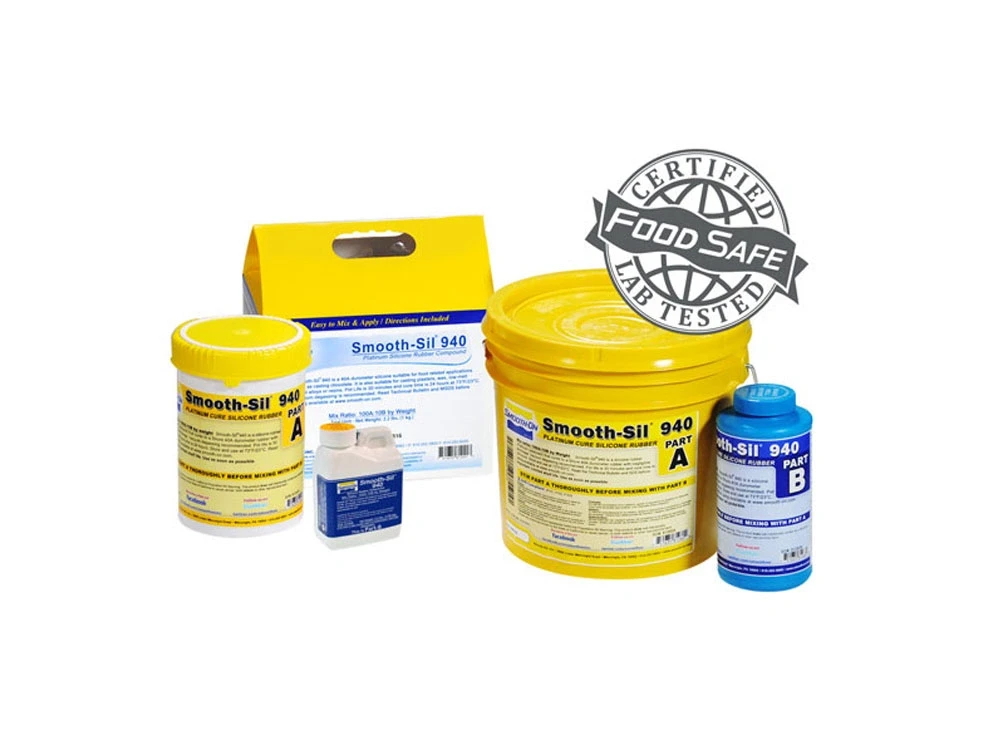
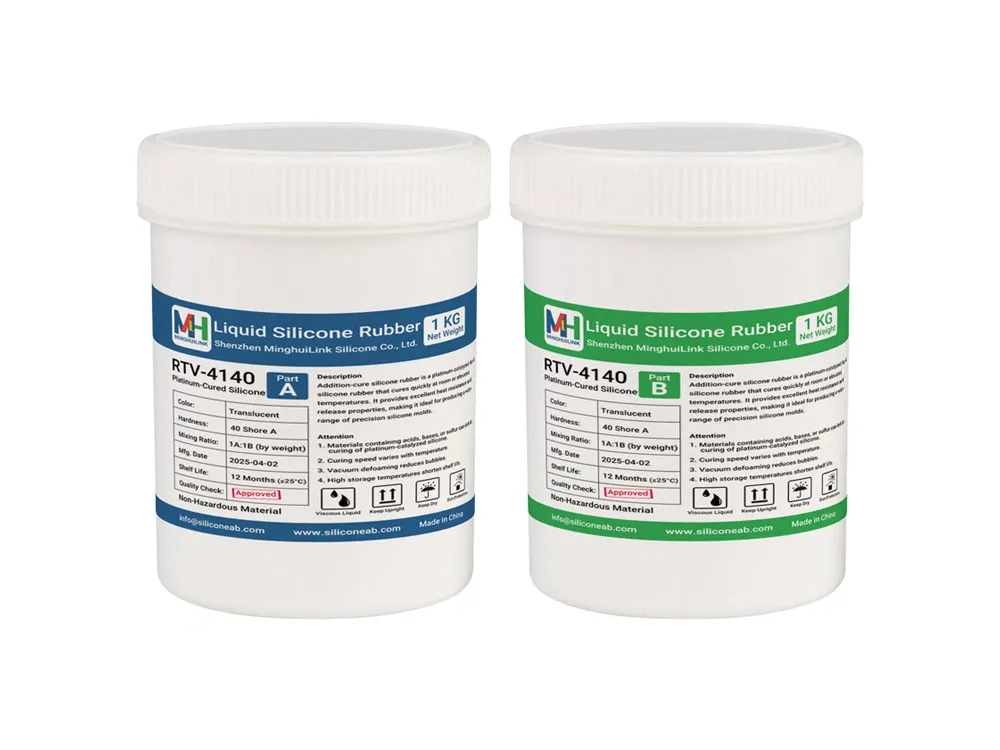
Smooth-Sil™ 940 and RTV-4140 occupy a closely matched Shore A40 range, giving both materials a relatively firm cured profile for reusable molds. At this hardness level, the silicone provides more body and resistance to deformation than softer mold materials, which can be useful for production molds, heavier castings and repeated handling.
The most obvious practical difference is the mixing system. Smooth-Sil™ 940 uses a 100A:10B ratio by weight, which requires accurate weighing with a scale. RTV-4140 uses a straightforward 1:1 ratio by weight or volume, making routine batch preparation simpler. For users making frequent small batches or working without specialized weighing equipment, the 1:1 system can reduce the amount of preparation required.
Processing and cure times create a different trade-off. Smooth-Sil™ 940 has a published 30-minute pot life and approximately 24-hour cure time, while RTV-4140 has a 30–40-minute working time and approximately 5–6 hours of cure under its stated conditions. The working windows are relatively close, but the final mold turnaround is substantially different. This can make RTV-4140 more convenient for faster prototyping or production cycles, while 940 may be suitable when a long cure cycle is acceptable.
Viscosity is also significantly different in the published specifications. Smooth-On reports 35,000 cps for Smooth-Sil™ 940, while MinghuiLink reports approximately 4,800 mPa·s for Part A of RTV-4140. Because the manufacturers report viscosity at different measurement points, these figures should not be treated as a direct like-for-like laboratory comparison. In practical use, the lower published viscosity of RTV-4140 may simplify pouring and handling, while Smooth-Sil™ 940 may require more attention to mixing, degassing and filling narrow details.
The published mechanical data show another difference in material profile. Smooth-Sil™ 940 reports approximately 4.14 MPa tensile strength, 17.5 N/mm tear strength and 300% elongation, while RTV-4140 reports 5.3±0.5 MPa tensile strength, 32±0.5 N/mm tear strength and 220±50% elongation. RTV-4140 therefore reports higher published tensile and tear strength, while Smooth-Sil™ 940 reports higher elongation. These figures should be treated as published reference values because manufacturer test conditions may differ.
Smooth-Sil™ 940 also has a specific food-grade positioning that distinguishes it from many general-purpose mold silicones. Smooth-On lists the material for food-related applications including baking, chocolate and other reusable molds. Final selection should therefore consider not only hardness and mechanical performance, but also food-contact requirements, mold geometry, casting material, mixing equipment and the desired production turnaround.