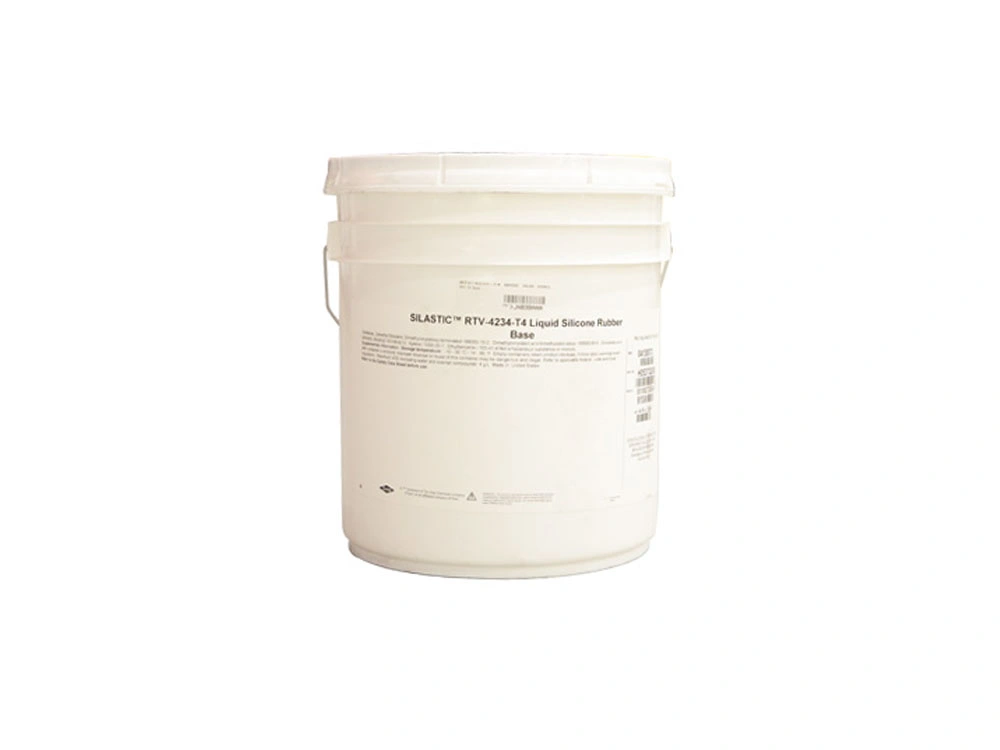
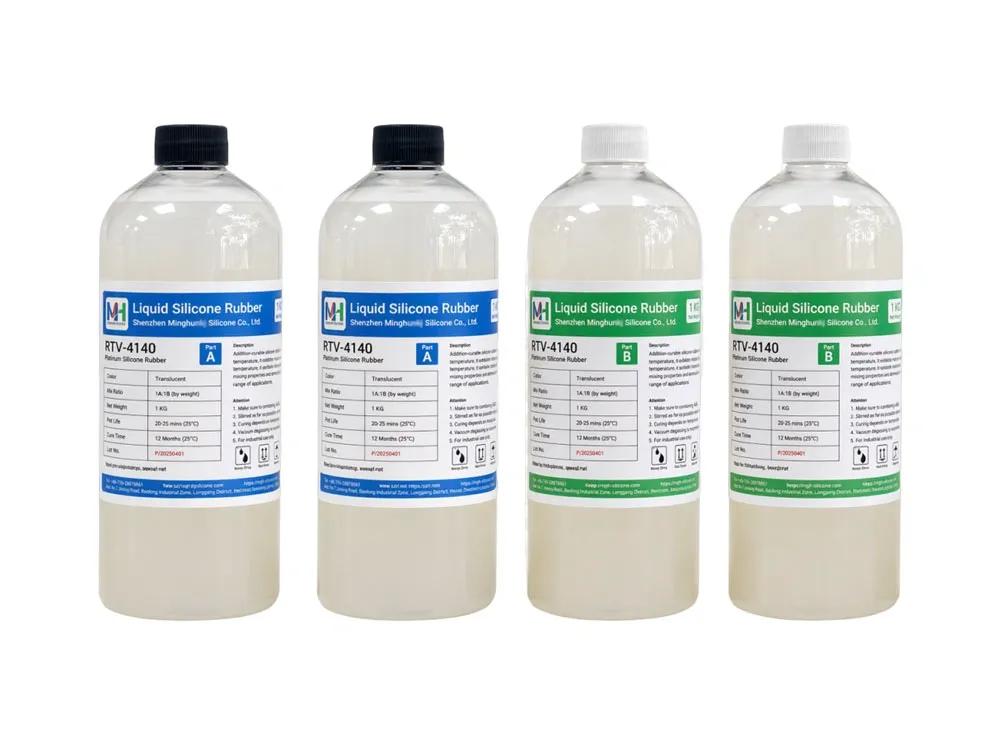
SILASTIC™ RTV-4234-T4 and RTV-4140 are both Shore A40-class addition-cure silicone systems for reusable mold making. Dow lists 40 Shore A for RTV-4234-T4, while MinghuiLink lists 40±1 Shore A for RTV-4140. The hardness is therefore effectively comparable, so selection depends more on mold geometry, processing requirements and mechanical priorities.
Dow positions RTV-4234-T4 as a flexible and tough mold-making material with outstanding release, very low shrinkage and good dimensional stability. Its 90-minute working time is a major advantage for large or complicated molds, giving operators more time for mixing, deaeration, positioning and controlled pouring. Dow also positions the material for prototype design, production tooling and rapid prototyping.
RTV-4140 follows a more production-oriented approach. Its 1:1 mixing system is simple for routine batching, while its published component viscosities of approximately 4,800±200 mPa·s for Part A and 4,300±200 mPa·s for Part B are substantially lower than the approximately 35,000 cP mixed viscosity published for RTV-4234-T4. Because the manufacturers report different material states, these values should not be treated as a strict like-for-like viscosity ratio.
The mechanical profiles also differ. RTV-4234-T4 publishes approximately 6.7 MPa tensile strength, 27 N/mm tear strength and 400% elongation. RTV-4140 publishes 5.3±0.5 MPa tensile strength, 32±0.5 N/mm tear strength and 220±50% elongation. RTV-4234-T4 therefore has higher published tensile strength and elongation, while RTV-4140 has the higher published tear-strength value.
These properties serve different purposes. Higher elongation is particularly useful when the mold must stretch during demolding, while tear strength is more directly related to resistance against crack or cut propagation. For complex replicas and difficult release paths, RTV-4234-T4's higher elongation and flexible/tough positioning can be important. For routine molds exposed to repeated handling, RTV-4140's higher published tear strength may also be relevant.
Working time favors RTV-4234-T4, at approximately 90 minutes versus 30–40 minutes for RTV-4140. This makes the Dow material more forgiving for large mold preparation or slower manual processing. RTV-4140 instead offers a shorter published cure cycle of approximately 5–6 hours, compared with approximately 12 hours of demold guidance for RTV-4234-T4.
RTV-4234-T4 also provides additional process options. Dow states that it can be heat accelerated when faster curing is required and can be modified to become thixotropic for non-flowable vertical-surface replication. Its translucent appearance can also help operators locate and cut split lines in block molds. These features may be valuable in specialized mold-making workflows.
Dow specifically lists polyester, cement, rigid polyurethane and plaster among the casting-material applications for RTV-4234-T4. RTV-4140 is positioned more generally for high-hardness reusable molds. Compatibility with the intended casting material should still be verified under the actual production conditions.
Overall, RTV-4234-T4 is better suited to users who prioritize long processing time, flexible removal of complex replicas, higher elongation and specialized mold-making options. RTV-4140 is better suited to routine production where lower published component viscosity, higher published tear strength, simpler processing and faster turnaround are more important. Neither material is universally superior; the best choice depends on the dominant molding constraint.