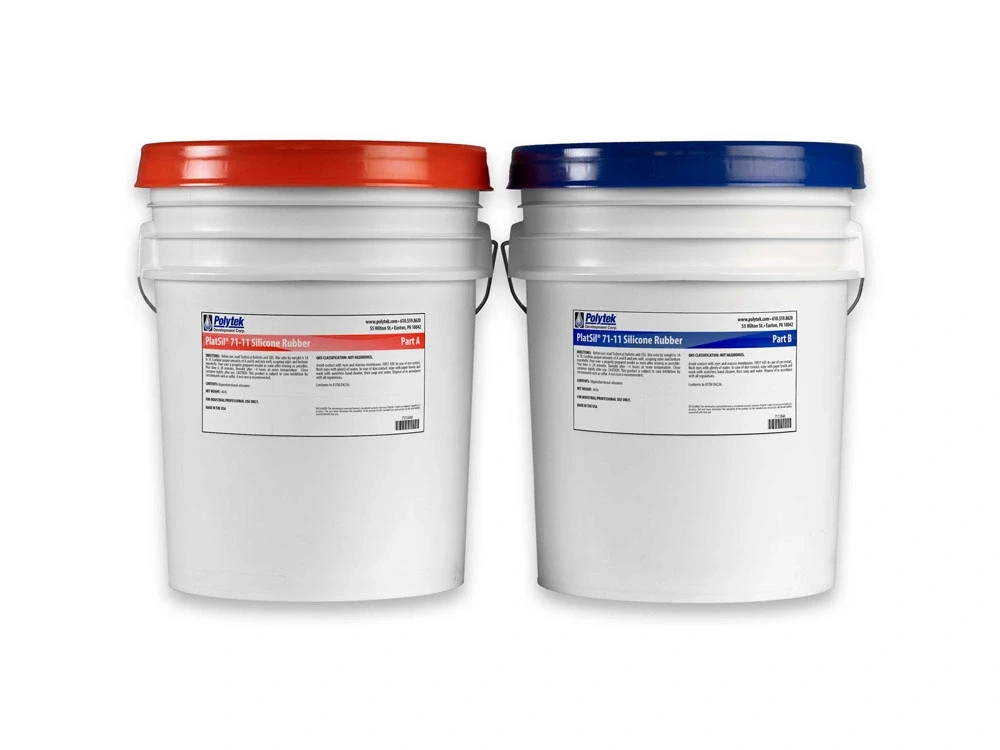
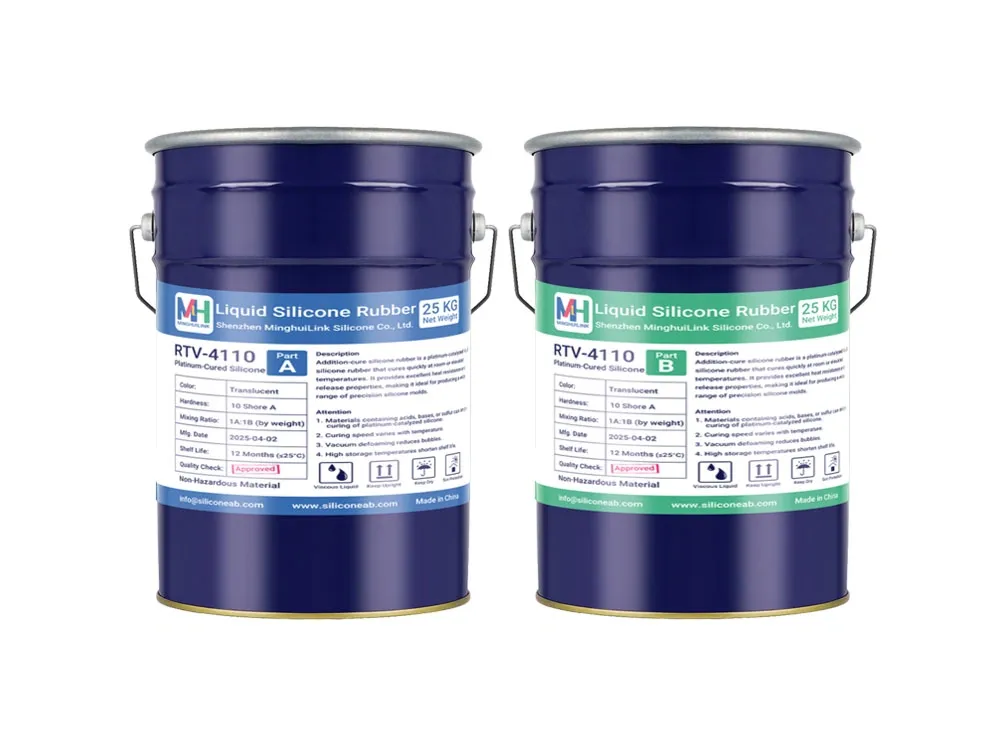
PlatSil® 71-11 and RTV-4110 are both Shore A10 platinum-cure silicones, placing them in a very soft and highly flexible mold range. At this hardness, flexibility and easy demolding are generally more important than structural rigidity. A10 silicone can be useful for deep undercuts, irregular shapes and peel-away molds, although large or thin-wall molds may require rigid external support during casting.
Both products use a straightforward 1:1 mixing system, so component ratio is not a major difference. Polytek specifies 1A:1B by weight for PlatSil® 71-11, while RTV-4110 can be mixed 1:1 by weight or volume. For routine batch preparation, both are relatively simple compared with silicone systems that use unequal component ratios.
The working windows show a clearer difference. Polytek lists a 20-minute pour time for PlatSil® 71-11, while MinghuiLink lists a 30–40-minute working time for RTV-4110. The shorter window of 71-11 favors a well-prepared workflow in which the mold, master and equipment are ready before mixing, while RTV-4110 provides more processing time for careful hand mixing, filling and air management.
The published demold times are broadly similar, with approximately 4 hours for PlatSil® 71-11 and 4–5 hours for RTV-4110. As a result, the more meaningful processing difference is the available working time rather than final mold turnaround. Users should also distinguish published demold times from the time required for the silicone to reach its final cured properties, particularly when the mold will be stretched or used repeatedly soon after demolding.
The mechanical data show a clear trade-off between stretchability and resistance to loading. PlatSil® 71-11 reports 751% elongation, compared with 510±50% for RTV-4110. RTV-4110, however, reports 4.0±0.5 MPa tensile strength and 25±0.5 N/mm tear strength, compared with 281 psi tensile strength and 117 pli Die B tear strength for PlatSil® 71-11. Because the manufacturers use different test methods and data presentation, the figures should be treated as published reference values rather than a direct laboratory ranking. The published data nevertheless indicate that 71-11 emphasizes stretchability, while RTV-4110 provides higher published tensile and tear strength.
PlatSil® 71-11 has a particularly specific application advantage in glove and sock molds. Polytek documents a workflow in which the silicone is applied in thin layers and then peeled or turned back over the model, with the final mold typically built to approximately 1/8 inch thickness. This makes the combination of very soft A10 hardness and high elongation especially relevant to flexible blanket-style molds. When used for casting, such thin and flexible molds may require a rigid support structure to maintain their shape.
RTV-4110 is positioned more broadly for flexible molds, intricate shapes and applications where easy demolding is important. Its lower published Part A viscosity and longer working window may appeal to users who prefer a relatively fluid material with more time for manual pouring. The final choice should therefore depend on whether the application prioritizes extreme stretchability and peel-away mold construction, or longer working time and higher published tensile and tear strength.