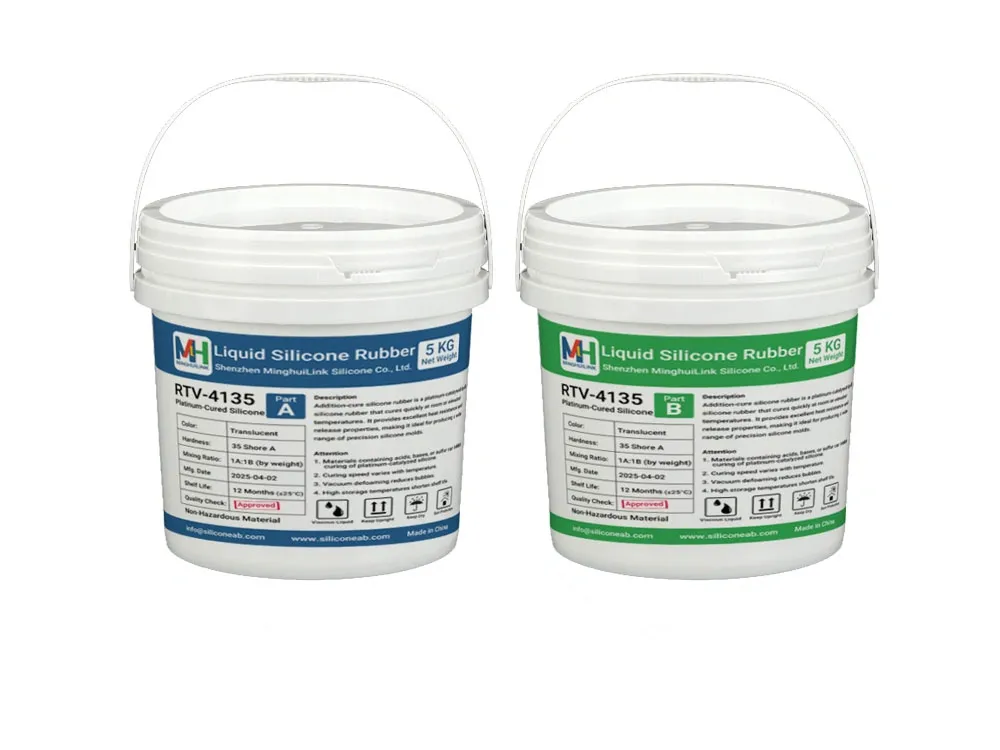
ELASTOSIL® M 4635 A/B and RTV-4135 are both addition-cure silicone systems in a similar medium-hardness range. WACKER lists M 4635 A/B at 37 Shore A, while MinghuiLink lists RTV-4135 at 35±1 Shore A. The small hardness difference means the more important selection factors are processing time, mechanical performance, viscosity and application requirements.
M 4635 A/B uses a 10:1 mix ratio and provides a 90-minute working time, compared with the 1:1 ratio and approximately 35-minute working time of RTV-4135. WACKER also publishes 20,000 mPa·s Part A viscosity and 700 mPa·s Part B viscosity for M 4635, while RTV-4135 publishes 4,500 mPa·s Part A and 4,000 mPa·s Part B. RTV-4135 is therefore simpler to batch manually and has lower published component viscosities, while M 4635 offers substantially more processing time.
The mechanical profile clearly favors M 4635 A/B. It publishes 7.0 MPa tensile strength, >30 N/mm tear strength and 480% elongation, compared with 4.8±0.5 MPa, 28 N/mm and 300±50% for RTV-4135. This combination gives M 4635 a stronger published profile for demanding molds, repeated handling and applications where both strength and flexibility are important.
Application positioning also differs. WACKER specifically positions M 4635 A/B for concrete casting, construction molding and reproduction of models with undercuts, where its higher hardness and mechanical properties can provide additional mold support. RTV-4135 is better characterized as a general-purpose A35-class mold silicone for routine casting applications. Large concrete or heavy-casting molds may still require a mother mold or support shell regardless of the silicone selected.
The published cure information favors RTV-4135 for routine turnaround: WACKER reports approximately 12 hours to a tack-free state for M 4635 A/B, while MinghuiLink lists approximately 5 hours curing time for RTV-4135. These are different published endpoints and should not be treated as a direct cure-rate comparison. Overall, M 4635 A/B is better suited to demanding reproduction and longer processing, while RTV-4135 is better suited to simpler, lower-viscosity and faster routine production.