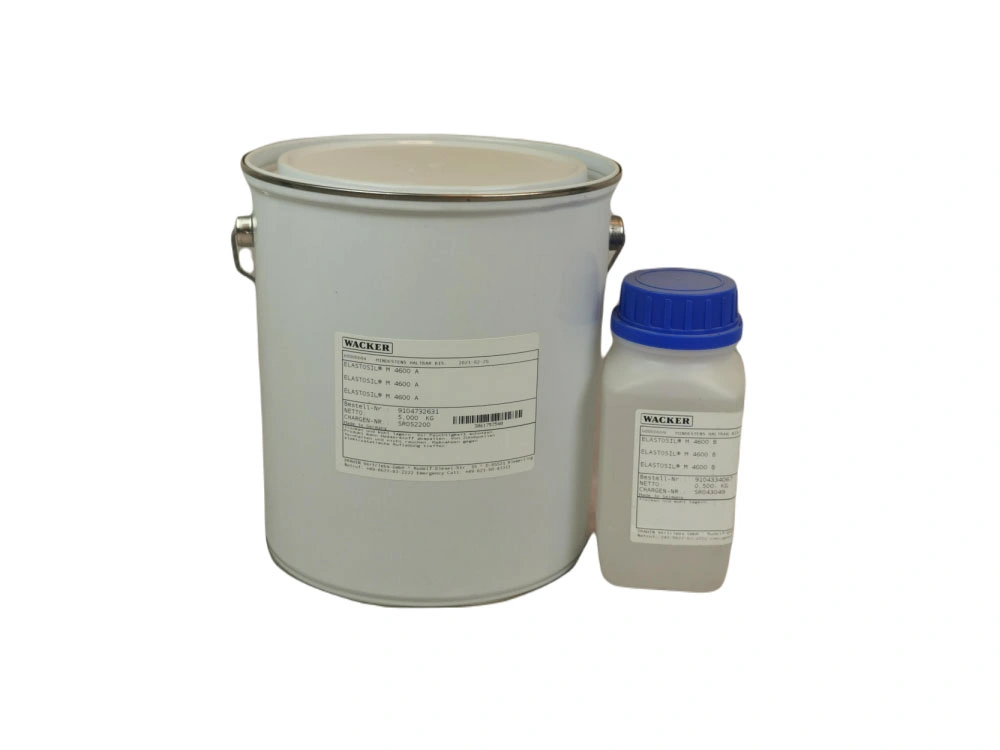
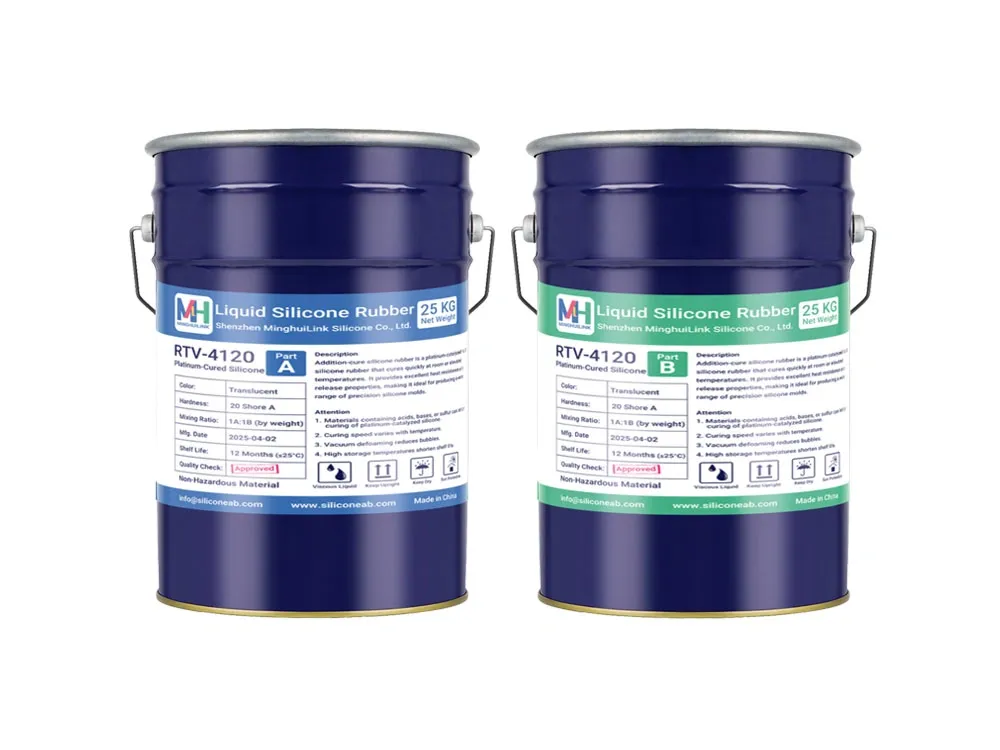
ELASTOSIL® M 4600 A/B and RTV-4120 are both Shore A20 addition-cure silicone systems for reusable mold making. WACKER lists M 4600 A/B at 20 Shore A, while MinghuiLink lists RTV-4120 at 20±1 Shore A. The hardness is therefore essentially equivalent, so the main differences are processing, mechanical performance and application focus.
WACKER positions M 4600 A/B as a high-performance mold-making silicone for accurate reproduction, including complex molds and pronounced undercuts. It provides a 90-minute working time, while RTV-4120 provides approximately 35 minutes. M 4600 A/B therefore offers substantially more time for large or detailed mold preparation, whereas RTV-4120 uses a simpler 1:1 mixing system and is easier to batch manually. RTV-4120 also publishes substantially lower component viscosities, although WACKER describes M 4600 A/B as having very good flow.
The mechanical profile favors M 4600 A/B in tensile strength and elongation. It publishes 7.0 MPa tensile strength and 800% elongation, compared with 5.0±0.5 MPa and 550±50% for RTV-4120. WACKER lists tear strength as >20 N/mm, while RTV-4120 publishes 27±0.5 N/mm. Because the WACKER figure is a threshold rather than an exact typical value, the tear-strength comparison should be treated cautiously. The much higher elongation of M 4600 A/B is particularly relevant when the mold must stretch around pronounced undercuts.
Both materials are suitable for flexible A20 molds and resin casting, but their application emphasis differs. M 4600 A/B is better aligned with demanding reproduction work, extensive undercuts, larger molds and applications where high elongation, tensile strength and dimensional accuracy are important. Its translucent appearance and reproduction positioning can also be useful for complex mold layouts. RTV-4120 is better suited to routine production where simple 1:1 processing, lower viscosity and faster curing are more important.
For large or heavy castings, both A20 materials may require a mother mold or external support to control deformation. Addition-cure compatibility should also be checked with 3D-printed masters, coatings and other potentially inhibitory surfaces before production. Overall, M 4600 A/B is the stronger choice for complex, high-performance reproduction, while RTV-4120 offers a simpler and faster workflow for general A20 mold production.