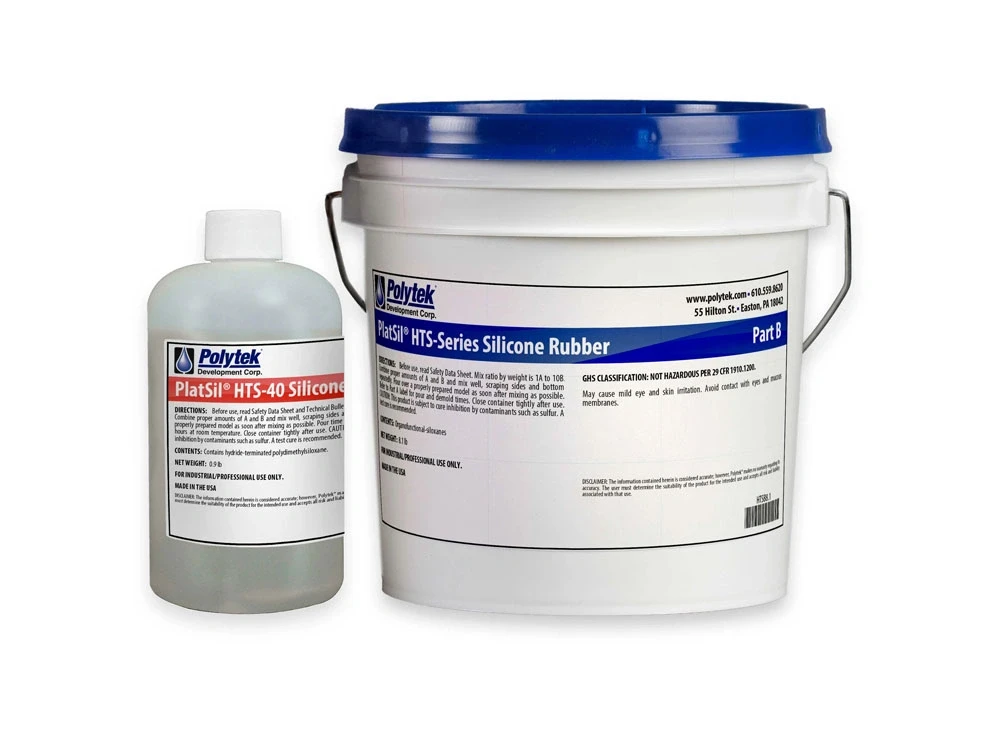
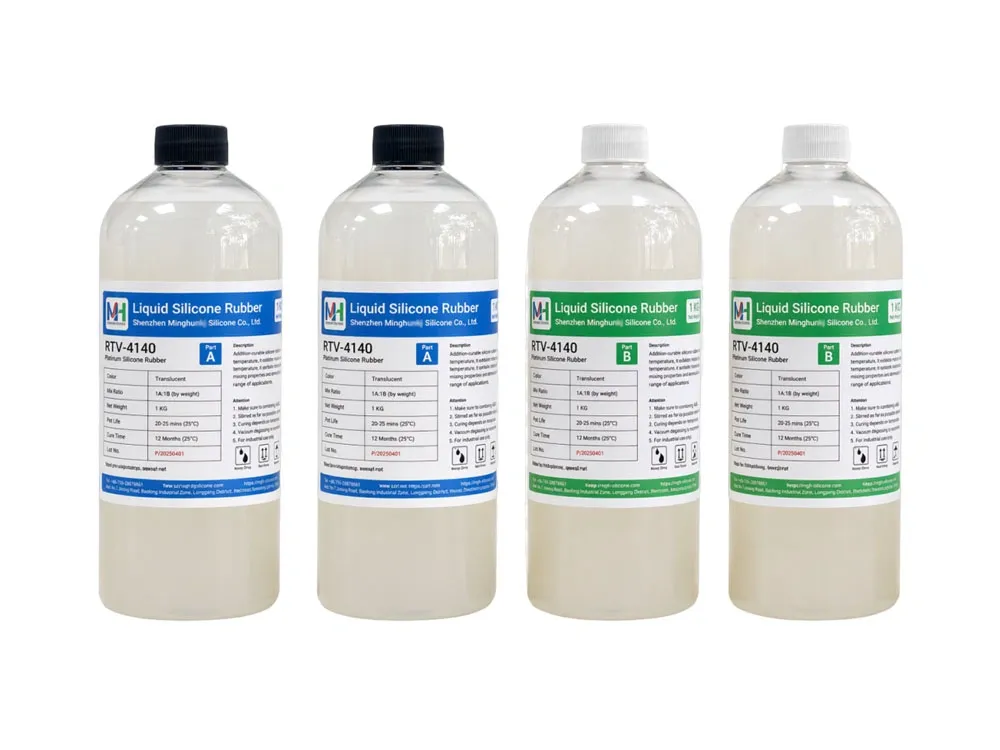
PlatSil® HTS-40 and RTV-4140 are both Shore A40 platinum-cure silicones, but HTS-40 has a more specialized production-oriented positioning. Polytek specifically describes HTS-40 for high-volume production and repeated demolding or stretching, making its combination of A40 hardness and high elongation the main point of differentiation from a general-purpose A40 mold rubber.
The component systems are substantially different. PlatSil® HTS-40 uses a 1A:10B ratio by weight, which requires accurate weighing for consistent batches. RTV-4140 uses a 1:1 ratio by weight or volume, making component measurement simpler for routine production. This is primarily a workflow difference rather than an indication of cured material performance.
The working windows are relatively close. Polytek lists a 30-minute pour time for HTS-40, while MinghuiLink specifies approximately 35 minutes for RTV-4140. The more significant processing difference is the cure or demold cycle: HTS-40 is listed at approximately 24 hours, compared with approximately 6 hours for RTV-4140. For users prioritizing rapid mold turnover, this difference can have a greater practical impact than the small difference in working time.
Viscosity is another notable difference, although the published values are not directly equivalent. Polytek reports approximately 17,000 cP for mixed HTS-40, while MinghuiLink reports approximately 4,800±200 mPa·s for Part A of RTV-4140. Because the manufacturers report viscosity at different measurement points, these figures should not be treated as a strict like-for-like laboratory ranking. They do, however, indicate different processing characteristics that may affect mixing, degassing and pouring technique.
The most distinctive mechanical difference is elongation. Polytek reports 831% elongation for HTS-40, compared with 220% for RTV-4140. This is particularly relevant for production molds that must repeatedly stretch during demolding, especially around undercuts, sharp features or large castings. Both materials are in the A40 hardness range, but HTS-40 combines that relatively firm mold profile with substantially greater published stretch capability. The published tensile values are in a broadly similar range, while tear-strength figures should not be directly ranked because the manufacturers use different test methods.
HTS-40 therefore offers a different balance from RTV-4140. HTS-40 is more strongly differentiated by its high elongation and production-oriented positioning, while RTV-4140 combines A40 hardness with a simpler 1:1 mixing system and a much shorter published cure cycle. For applications involving frequent demolding or substantial mold stretching, the published elongation of HTS-40 may be especially relevant.
HTS-40 can also be thickened with PlatThix Liquid Thickener or fumed silica for brush-on mold construction, giving it additional flexibility for large, vertical or irregular patterns. Final selection should therefore consider production volume, demolding frequency, required stretchability, mold geometry, mixing method and acceptable mold turnaround.