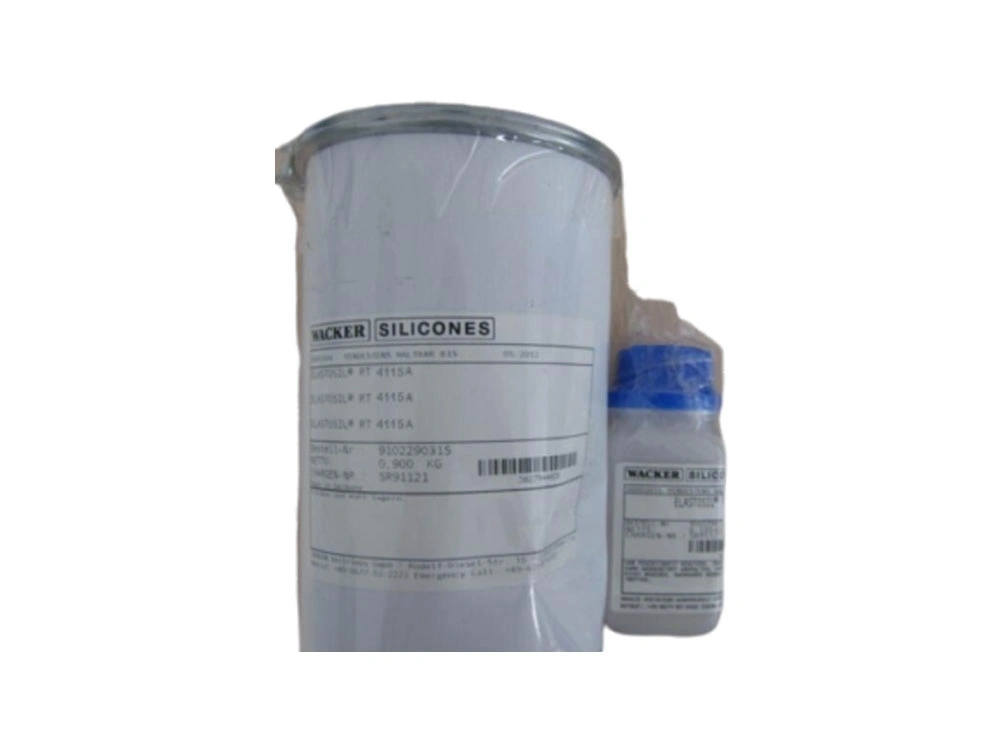
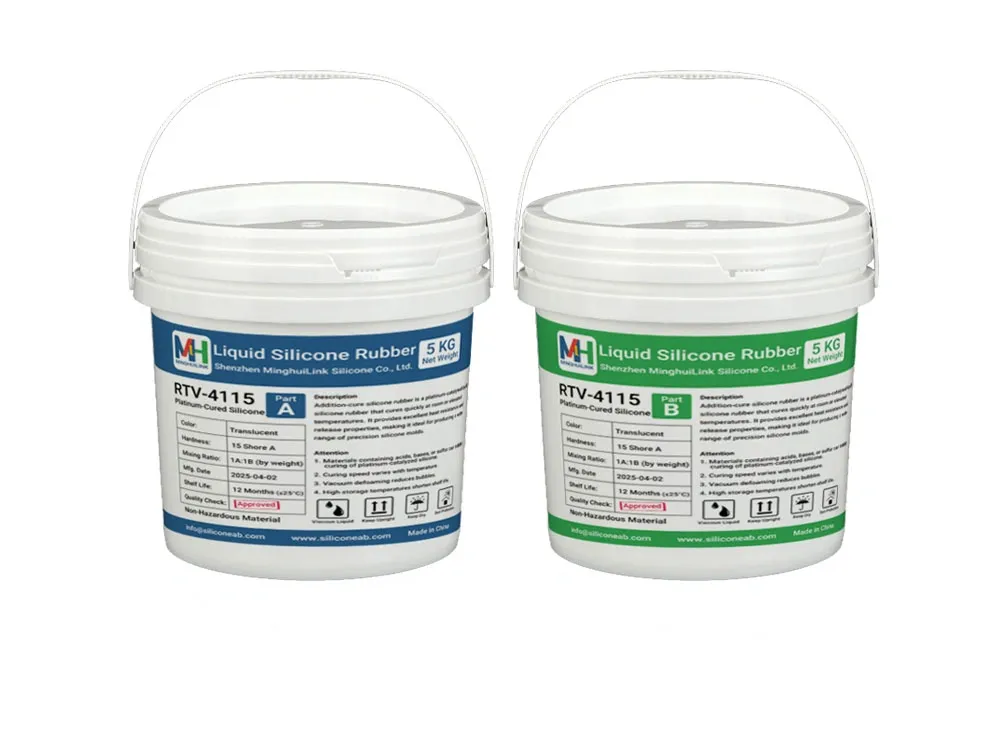
ELASTOSIL® M 4115 A/B and RTV-4115 are both very soft addition-cure silicone systems for flexible reusable molds. WACKER lists M 4115 A/B at 17 Shore A, while MinghuiLink lists RTV-4115 at 15 Shore A. The small hardness difference is less important than the differences in working time, demolding speed, viscosity and mechanical strength.
M 4115 A/B is positioned by WACKER for accurate reproduction and models with pronounced undercuts. Its low component viscosity of approximately 2,500 mPa·s, combined with a fast published demoldable time of about 60 minutes, makes it attractive for fine-detail molds and applications where rapid mold turnaround is important. RTV-4115 uses the same 1:1 mixing system but provides a much longer 35-minute working time.
The working-time and curing profiles create the clearest production trade-off. M 4115 A/B has only about 12 minutes of pot life, so mixing and pouring must be completed quickly, but the mold can reach a demoldable state much sooner. RTV-4115 provides nearly three times the working time, making it easier for manual mixing, degassing and controlled pouring, but its published cure time is approximately 5 hours.
Mechanical properties favor RTV-4115 on the published numerical data. M 4115 A/B lists approximately 3.0 MPa tensile strength, 5 N/mm tear strength and 400% elongation, compared with 5.0 MPa, 26 N/mm and 450% respectively for RTV-4115. This gives RTV-4115 a substantially stronger published mechanical profile, particularly for thin mold edges, repeated peeling and frequent handling.
For difficult demolding, both products remain viable because they are very soft silicones. M 4115 A/B has a specific WACKER positioning for pronounced undercuts and combines 17 Shore A hardness with low viscosity and rapid demolding. RTV-4115 is slightly softer at 15 Shore A and has higher elongation, so it may be preferable where a longer processing window and greater flexibility are more important than rapid turnaround.
Both materials are suitable for detailed flexible molds, but very soft silicone may require external support for large molds or heavy castings. RTV-4115 also publishes a heat-resistance specification of up to 250°C / 482°F, while no equivalent numerical long-term service-temperature value is listed in the referenced WACKER information. As with other addition-cure silicones, compatibility testing is recommended for unfamiliar masters, coatings and 3D-printed surfaces.
Overall, ELASTOSIL® M 4115 A/B is better aligned with rapid mold production, low-viscosity pouring and explicitly difficult undercut reproduction. RTV-4115 is better aligned with longer manual processing time, slightly softer flexibility and substantially higher published tensile and tear strength.