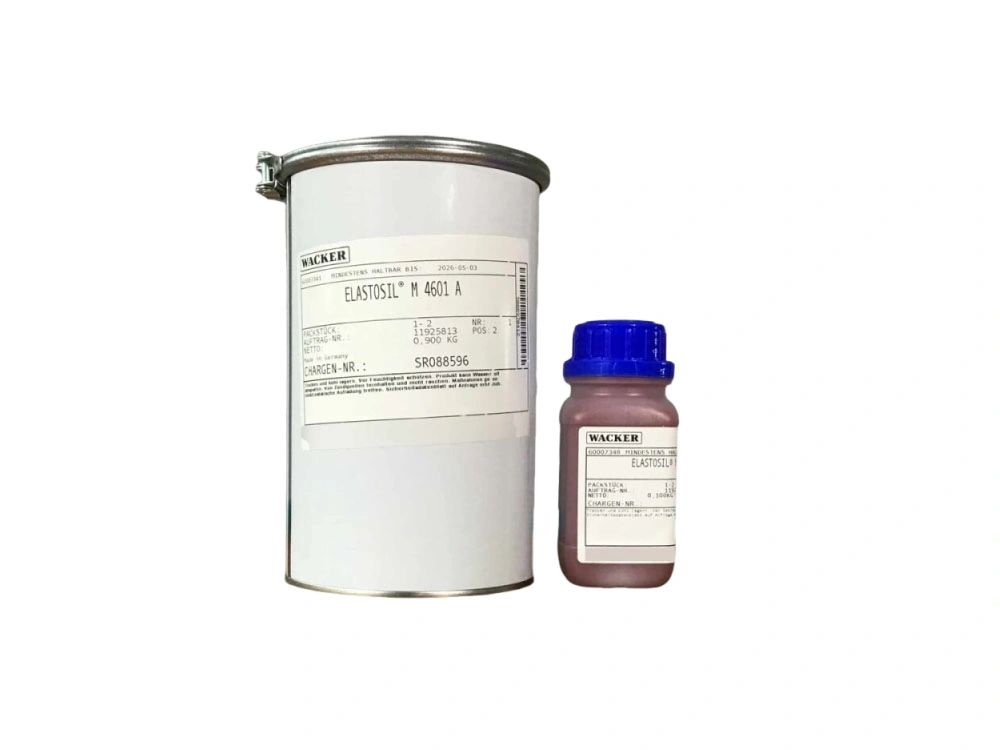
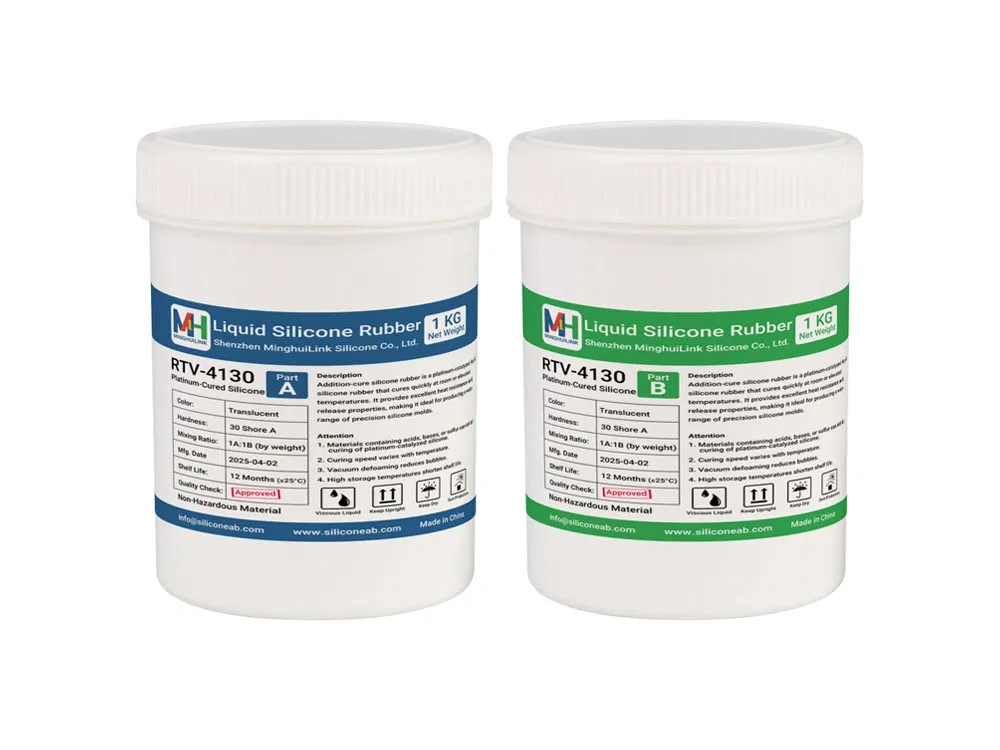
ELASTOSIL® M 4601 A/B and RTV-4130 are both addition-cure silicone systems for reusable mold making, with similar medium-soft hardness. WACKER lists M 4601 A/B at 28 Shore A, while MinghuiLink lists RTV-4130 at 30±1 Shore A. The difference is relatively small, so the main selection factors are processing time, viscosity, mechanical performance and application requirements.
M 4601 A/B is positioned as a high-performance reproduction silicone for demanding molds and extensive undercuts. It combines a 9:1 mixing ratio, 90-minute pot life, high tensile and tear strength, 700% elongation, low shrinkage and resistance to common casting resins, particularly polyurethane. RTV-4130 uses a simpler 1:1 system, with approximately 35 minutes of working time and substantially lower published component viscosities, making it more convenient for routine manual processing.
The processing trade-off is clear. M 4601 A/B provides much more working time for large masters, vacuum deaeration and controlled pouring, but requires more accurate 9:1 proportioning and has higher published component viscosity. RTV-4130 is easier to measure and pour, while its shorter working window favors smaller or more efficiently organized production. For curing, WACKER reports approximately 12 hours to a tack-free state for M 4601 A/B, compared with approximately 5 hours cure time for RTV-4130; these are different published endpoints, but RTV-4130 is better aligned with faster routine turnaround.
Mechanical performance favors M 4601 A/B. It publishes approximately 6.5 MPa tensile strength, >30 N/mm tear strength and 700% elongation, compared with 5.0±0.5 MPa, 28±0.5 N/mm and 400±50% respectively for RTV-4130. The higher elongation and strength profile makes M 4601 A/B particularly attractive for demanding reproduction and repeated flexing around undercuts, while RTV-4130 provides a balanced mechanical profile with slightly greater cured body at 30 Shore A.
Application positioning also differs. M 4601 A/B is specifically associated with accurate reproduction, extensive undercuts, resistance to casting resins and applicable food-contact uses stated by WACKER. RTV-4130 is better suited to general-purpose A30-class mold making where simple mixing, lower published viscosity and faster turnaround are more important. Both can be considered for resin casting and 3D-printed masters, but compatibility with the actual casting material, printing resin and surface treatment should be verified before production. Large molds may also require external support regardless of which material is selected.
Overall, M 4601 A/B is the stronger choice for demanding reproduction, extensive undercuts, high elongation and longer processing time. RTV-4130 is the more straightforward option for routine production, with 1:1 mixing, lower published component viscosity and faster published curing. The better fit depends mainly on mold complexity, required working time, production speed and mechanical demands.