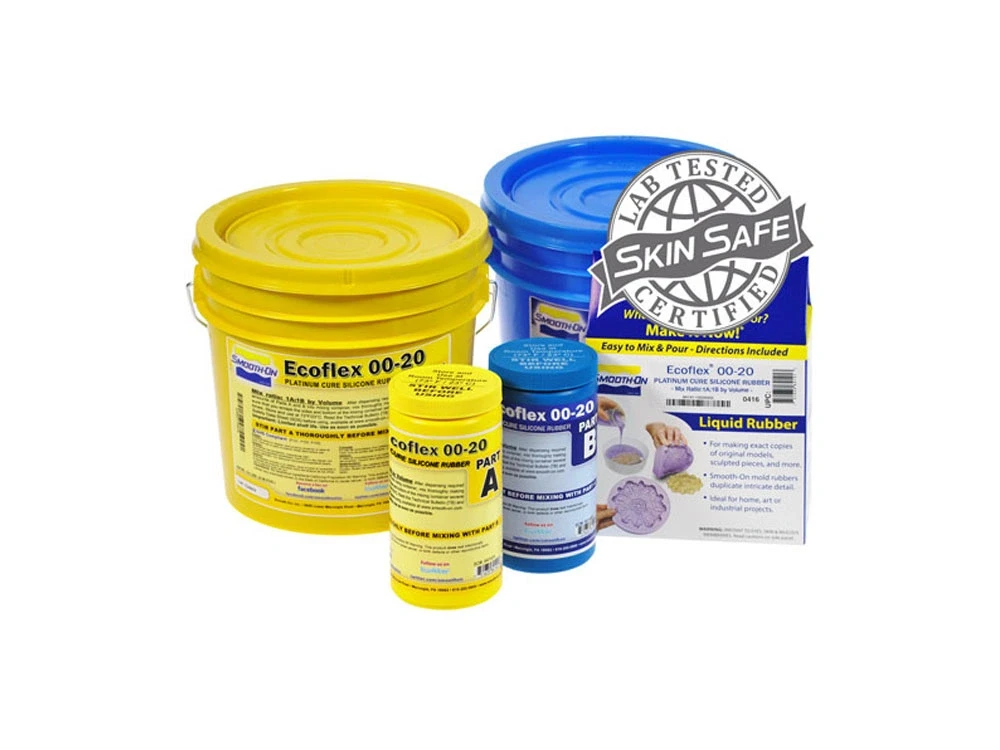
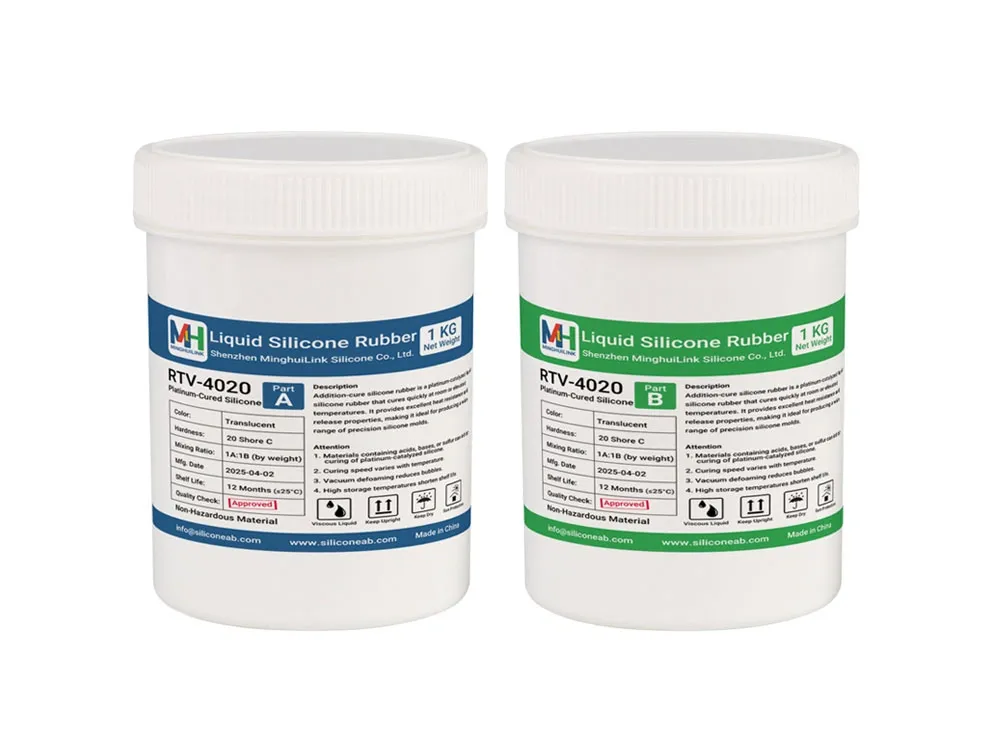
Ecoflex™ 00-20 and RTV-4020 are both very soft platinum-cure silicones specified at 20 Shore OO. With the same nominal hardness, the more meaningful differences are in their published elongation, tear strength, viscosity, processing characteristics and application positioning. In practical use, both materials are intended for applications where softness and flexibility are important.
Flexibility and resistance to deformation are particularly relevant when the cured silicone is used for skin-like surfaces, soft molds or repeated movement. Smooth-On reports 845% elongation and 30 pli tear strength for Ecoflex™ 00-20, while MinghuiLink reports 560±50% elongation and 4±0.5 N/mm tear strength for RTV-4020. The published figures indicate a different mechanical profile, with Ecoflex™ 00-20 showing substantially higher reported elongation and tear strength.
Both materials are relatively manageable during processing. Smooth-On lists a 30-minute pot life and 4-hour cure time for Ecoflex™ 00-20, while MinghuiLink lists a 30–40-minute pot life and 4–5-hour cure time for RTV-4020. The published ranges overlap, so neither product has a major processing-time advantage based on these figures alone.
Viscosity is another area where the published specifications differ. Ecoflex™ 00-20 has a mixed viscosity of 3,000 cps, while RTV-4020 is listed at 2,200±200 cps mixed. Both are relatively low-viscosity materials compared with many mold-making silicones, which can help with mixing and air release. Actual flow and bubble behavior should still be evaluated with the intended mold geometry and pouring method.
For life casting, prosthetic-related work, flexible molds and soft silicone components, material choice should therefore be based on the required softness, stretch capability, tear resistance, skin-contact requirements and mold geometry. Ecoflex™ 00-20 has specific published positioning for prosthetic appliances, orthotic cushioning and animatronics, while RTV-4020 is part of MinghuiLink's dedicated life-casting silicone range.